
The Tickets That Survive Your AI Filter Are the Hardest Ones Your Team Has Ever Seen

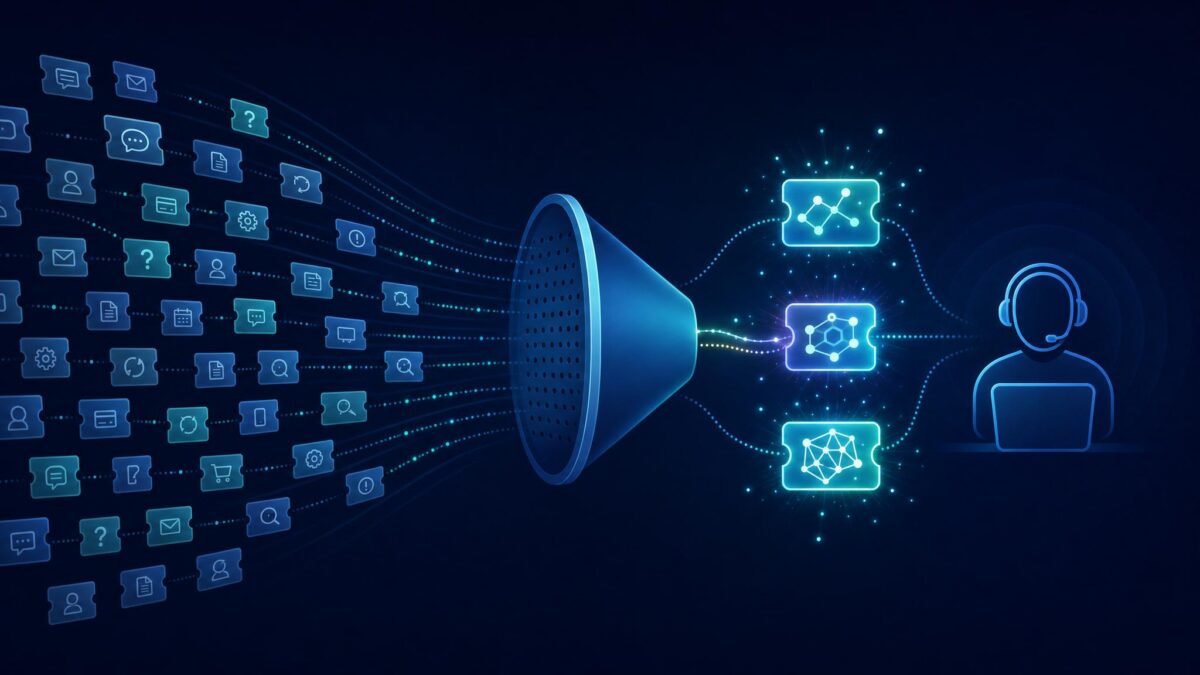
Zendesk Relate 2026 made something official that most support leaders already knew but weren’t saying out loud: human support agents are becoming “service engineers.” Their job is no longer to handle tickets. Their job is to design the AI workflows that handle tickets. That shift also creates the agentic support human handoff problem. When AI handles 60 percent of volume, every ticket that reaches a human is one AI couldn’t solve. The handoff layer doesn’t get simpler. It gets harder.
AI deflection doesn’t reduce the complexity of your support operation. It concentrates it.
What Actually Happens When AI Deflects 60 Percent of Your Tickets
The pitch is straightforward: deploy AI, deflect first-line volume, reduce headcount costs, improve response times. And for a lot of companies, the numbers actually work out. Deflection rates of 40 to 80 percent are real. The ROI math is easy to run.
What doesn’t show up in the math is what’s left.
When your AI handles the FAQ tickets, the “what’s my order status” tickets, the “how do I reset my password” tickets, the residual queue doesn’t stay the same and just get smaller. The residual queue gets harder. Every ticket that survives the filter is one the AI couldn’t solve. By definition, you’re now looking at the top of your complexity distribution, served at scale.
Teams respond to lower volume the way any rational organization responds to lower volume: they reduce headcount to match. If you used to need 20 agents to handle 1,000 tickets per day and AI deflects 600 of them, you don’t need 20 agents anymore. You need 8. The math makes sense.
What the math doesn’t capture is that those 8 agents are now handling the hardest 400 tickets instead of a mix of 1,000 tickets ranging from simple to complex. They’re handling a queue with no easy wins. No warm-up. Every ticket is the hard one. This is the core of the agentic support human handoff challenge no ROI model accounts for.
The Agentic Support Human Handoff Training Problem Nobody Talks About
Support teams were trained for a specific kind of work. Not just trained on product knowledge, but trained on a cadence that includes easy tickets, medium tickets, and hard tickets in some natural distribution. That mix keeps agents sharp on the basics while building the skills to handle escalations.
When AI deflection removes the bottom tier of volume, you don’t just lose the easy tickets. You lose the scaffolding.
Agents who used to build confidence on straightforward cases before graduating to complex ones now face complex cases immediately. The team gets rustier on the cases they used to warm up on. And the cases they now see aren’t just harder in terms of product knowledge. They’re harder in terms of emotional temperature.
Every customer who made it through your AI filter is a customer who already tried the bot. Probably twice. Maybe three times. They’re not coming in neutral. They’re coming in with a story: “I already tried your automated thing and it didn’t work.” That’s the emotional context your agent is walking into before they’ve said a word. This is a pattern also visible in field service misdiagnosis data: agents working harder queues make more costly errors, not fewer.
AI Filtration Concentrates Frustration, Not Just Complexity
There’s a specific kind of customer experience failure that happens in stages. First, someone hits a problem. Second, they try to solve it themselves. Third, they try your AI. Fourth, the AI fails them. Fifth, they finally reach a human.
By step five, they’re not just frustrated about the original problem. They’re frustrated about the process. Every failed deflection attempt adds to the total frustration your agent has to absorb before they can even start solving anything.
This is the support problem nobody put in the deflection rate ROI model: when AI can’t solve it and a human finally picks it up, the customer arrives pre-frustrated. Your agent now has to do emotional reset work before diagnostic work. That’s a different skill set than what most support training programs develop.
These Aren’t FAQ Tickets Anymore
Let’s be specific about what types of problems actually make it through a well-tuned AI filter in 2026.
They’re not “how do I update my billing info.” That’s deflected. They’re not “what’s your return policy.” Deflected. They’re not “my login isn’t working.” Also deflected, with a password reset link.
What makes it through is a different category entirely. Complex multi-step failures where the AI got partway through a resolution and something broke. Equipment issues where the error message isn’t in the knowledge base because the failure mode is rare or new. Configuration problems where the customer’s specific setup doesn’t match the documented workflow. Physical problems where the product is behaving in a way that doesn’t match any known description.
These tickets have one thing in common: to diagnose them properly, someone needs to actually understand what’s happening. Not what the customer says is happening. What is actually happening. And in a large portion of cases, that requires seeing it. That’s why getting the agentic support human handoff right means giving agents tools that go beyond text.
The Handoff Layer Needs Visual Support
The conversation in support technology right now treats AI deflection and human support as two separate things, sometimes even as competing things. Deflect more with AI, need fewer humans. That framing misses what’s actually happening.
When AI deflects 60 percent of tickets and the remaining 40 percent are the hardest ones in your queue, the question isn’t whether you have enough agents. It’s whether your agents have the right tools to solve problems that resisted automated resolution. This is exactly what visual support research shows: the problems AI can’t solve are disproportionately the ones that require seeing the physical situation.
A ticket that survived your AI filter survived because the AI couldn’t get enough information, match the problem to a solution, or verify that its proposed fix actually worked. Those are information and verification problems. And the most direct solution to information and verification problems, for physical products and equipment and configurations that exist in the real world, is to see the problem.
A support link that opens a customer’s camera isn’t a competitor to your AI deflection layer. It’s what happens after deflection fails. It’s the agentic support human handoff tool for exactly the class of problems that AI couldn’t handle: the ones that require a human who can see what’s actually going on.
Viewabo sits in that exact layer. When your AI can’t solve it, when your agent needs to see the physical product, when the customer is trying to describe something they can’t put into words, you send a link and open a camera. No app download. No complicated setup. Just a direct visual connection between the agent who needs to diagnose and the customer who has the problem in their hands.
The Question You Should Be Asking
The support industry is spending a lot of time asking how to increase deflection rates. That’s a useful question. But the more important question, the one that’s going to determine whether the remaining support operation actually works, is this: what does your team need to be extraordinary at, now that they only see the hardest 15 percent of problems?
That’s not a cost efficiency story. That’s a quality story. And right now, most teams aren’t ready for it.
AI filtration is creating a support quality crisis in slow motion. The deflection rate is up. The volume is down. The remaining tickets are harder, the customers are angrier, and the agents are handling a distribution of problems they weren’t trained for.
The fix isn’t more deflection. The fix is making your human support operation extraordinary at exactly the kind of problems AI can’t solve. That starts with getting the agentic support human handoff right: giving your agents the ability to see what they’re dealing with, the moment the AI passes the problem to a human.