
AI Support Backlash: Companies Firing Their Teams Are Getting a Nasty Surprise

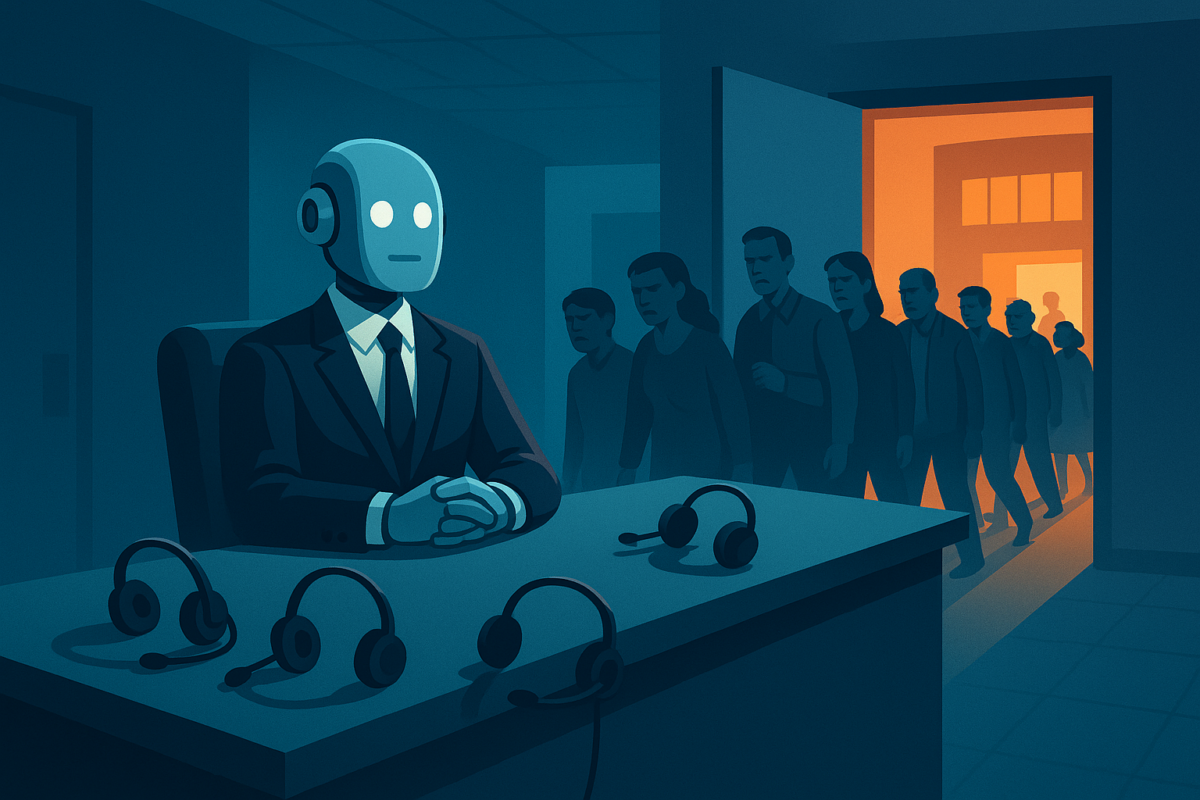
Ai support backlash is reshaping how we think about this topic. The pitch was irresistible: replace your customer support team with AI, cut costs by 40-60%, and scale infinitely without headcount.
Furthermore, companies bought in. They cut agents. Meanwhile, they deployed chatbots. Moreover, they pointed to deflection rates and celebrated.
However, now the AI support backlash is here , and it’s hitting harder than anyone expected.
Moreover, a nationwide consumer report found that 75% of customers felt AI-driven support responses left them frustrated. Moreover, SurveyMonkey’s 2026 research shows 79% of Americans prefer speaking with a person over an AI agent,. 89%. Believe companies should always offer human support options. Perhaps most damning: 53% of customers say they’d switch to a competitor if AI becomes the primary mode of support.
In addition, this isn’t a perception problem. On the contrary, this is a churn problem hiding in plain sight.
The AI Support Backlash Has Already Started Rehiring
Also, the most telling signal isn’t coming from surveys , instead. It’s coming from the companies that went furthest down the AI-only path. Are now quietly reversing course.
Specifically, klarna, the Swedish fintech that became the poster child for AI-powered support. Cut hundreds of customer service jobs and shifted aggressively to automation. However, their CEO publicly acknowledged that the cuts had gone “too far.”. A result, they’ve since rehired human staff after widespread customer dissatisfaction.
Consequently, they’re not alone. The Washington Times reported that e-commerce. Financial technology companies are quietly rehiring customer service workers they had replaced with AI bots. Driven by complaints from frustrated customers. Furthermore, the Glance 2026 CX Trends Report , surveying over 600 U.S. consumers , found that frustration is. Rising despite faster, automated responses.
Therefore, read that again: responses are faster, but customers are more frustrated. In other words, speed was never the problem. Understanding was.
The Pattern of Failure Behind the Backlash
Meanwhile, the stories are remarkably consistent across industries:
For example, eventbrite users have flooded Trustpilot and Reddit with complaints about being unable to resolve issues. For instance, their AI system repeatedly cycles through generic responses for refunds and account lockouts. One reviewer described receiving the same AI-generated response for over two months.
In other words, zomato customers reported that AI-only support offered coupon codes instead of meaningful assistance during urgent situations. As a result, there was no path to reach a human representative when it mattered most.
Similarly, intel replaced much of its traditional support with an AI assistant called “Ask Intel”. Part of a “digital-first” model. The company itself warns that its accuracy “is not. Perfect.” Consequently, some issues still require escalation , but the escalation paths are now harder to find.
Indeed, the pattern is always the same: AI handles the easy stuff well. Then catastrophically fails the moment a problem requires nuance, empathy, or visual context.
Why AI-Only Support Fails at the Moments That Matter
In fact, aI support systems are fundamentally text-based reasoning engines. They’re excellent at pattern matching against known issues. They’re fast, consistent, and tireless.
However, the interactions that determine whether a customer stays or leaves aren’t pattern-matching problems. Instead, they’re situations that require:
- Seeing the actual problem. When hardware is broken or a setup is wrong, no amount of text exchange can replace actually seeing what the customer sees. For example, AI can’t look at a blinking error light and know what it means.
- Reading emotional context. A frustrated customer who’s been stuck for three days doesn’t want efficient resolution , they want to feel heard first. Although AI can simulate empathy, Pega’s 2026 research found that 68% of people are not confident about how businesses use generative AI in interactions.
- Exercising judgment. Should this customer get an exception? Is this issue a symptom of a larger product problem? These are judgment calls that require understanding, not just information retrieval.
- Navigating complexity. Multi-step issues that span previous interactions and edge cases are where AI loops and repeats itself. Consequently, the customer gives up entirely.
The Real Cost of “Cost Savings”
Of course, when companies calculate the ROI of replacing human agents with AI. They typically measure direct cost reduction: fewer salaries, fewer benefits, fewer desks.
Naturally, what they don’t measure , until it’s too late:
- Churn acceleration. Because 53% of customers will switch companies if AI dominates support, a SaaS company with $10M ARR facing even a 5% increase in churn loses $500K annually , far more than the support team they cut.
- Reputation damage. Trustpilot reviews, Reddit threads, and social media complaints are effectively permanent. As a result, they influence every future prospect’s buying decision.
- Rehiring costs. Companies like Klarna that went too far are now spending to rehire, retrain, and rebuild institutional knowledge. In fact, the cost of rebuilding a support team is always higher than maintaining one.
- Security exposure. AI systems using natural language processing are vulnerable to prompt injection attacks. Therefore, customer-facing AI creates attack surfaces that didn’t exist before.
The Model That Actually Works
The companies getting this right aren’t choosing between AI and humans. Instead, they’re building hybrid models where each does what it’s best at:
AI handles volume. Routine queries, FAQ-style questions, order tracking, and password resets , the high-volume, low-complexity interactions where speed and consistency matter most. This is where AI genuinely shines.
Humans handle value. Complex issues, emotional situations, visual problems, and high-stakes interactions , the moments that determine loyalty. Moreover, these agents aren’t doing the same job as before. They’re armed with AI-powered context and visual tools that make them dramatically more effective.
Visual tools bridge the gap. The biggest failure point in AI-to-human escalation is context loss. For instance, the customer re-explains everything while the agent starts from scratch. Visual support , where the agent can actually see what the customer sees through live video , eliminates this entirely. As a result, the escalation moment becomes the best part of the experience, not the worst.
This isn’t a theoretical framework. On the contrary, it’s what the companies with the highest CSAT and lowest churn are already doing.
The Nasty Surprise
Here’s what the companies that fired their support teams don’t see coming: their competitors who kept humans ,. Made them better with AI , are about to eat their lunch.
While AI-only companies celebrate deflection rates, hybrid companies are building customer loyalty that compounds. Every resolved complex issue becomes a retention event. Similarly, every moment of genuine human understanding becomes a competitive moat.
The data behind the AI support backlash is overwhelming:
- 75% of customers prefer human agents
- 53% will switch to competitors with better human support
- 89% want human options always available
- Companies are already rehiring after going too far
The nasty surprise isn’t that AI doesn’t work , it does, for the right things. The surprise is that the cost savings from eliminating humans are dwarfed. By the revenue loss from customers who leave because the humans are gone.
Ultimately, the companies that win the next decade won’t be the ones that automated the most. They’ll be the ones that figured out the right balance , and invested in making the human moments extraordinary.
The race to zero human agents was always a race to the bottom. The smart money is on the companies running the other way.
See also: visual customer support.
For additional context, see OpenAI’s research on AI capabilities.