
Anker Visual Support: Treat Charging as a Complete Chain

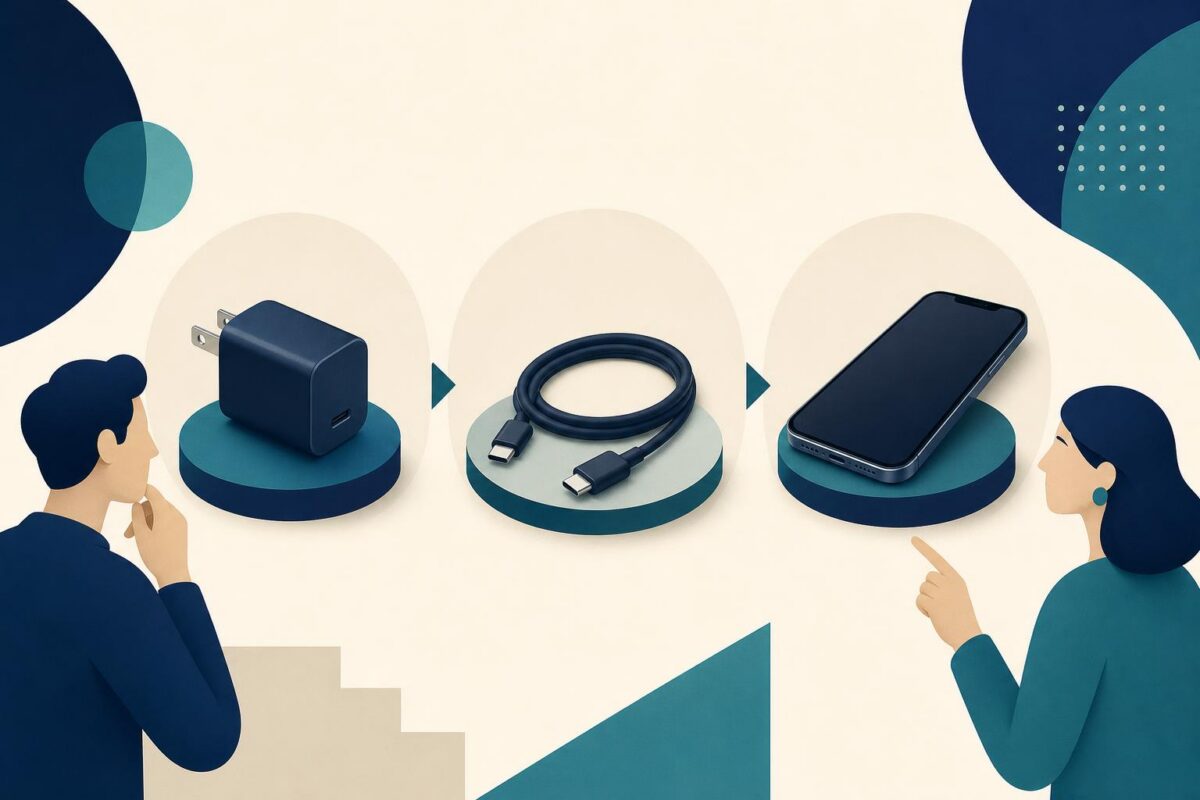
Anker visual support could help when a charging complaint is assigned to one object before the full arrangement is understood. A customer may blame the charger while describing a cable, a device, and a power source only loosely. Support needs to identify that complete chain and the exact result the customer expected.
This makes charging support a strong prospective fit for Viewabo. This is an independent analysis, not a statement that Anker uses or endorses Viewabo.
A charging brand serves more than one kind of setup
Anker’s December 2021 product-series explanation describes its charging business and the way it organizes products for customers. That broad portfolio context matters because a brand name alone cannot identify the accessory in a support case.
Our independent Belkin accessory analysis explores why identification must precede a compatibility recommendation.
In a hypothetical example, a customer reports that a device is charging slowly. The agent should first ask what they observed, over what period, and under which normal conditions. Slow is a useful description of the experience, but it is not yet a diagnosis.
Identify the charger, cable, and powered device separately through the appropriate product information. Keep any uncertain identity explicit. A support process should not silently fill in a model name because an object looks familiar.
Anker visual support could make the chain understandable
A shared view can help the customer and agent agree on the relevant objects and their accessible arrangement. The customer may point out the charger they are actually using rather than the one they remember purchasing. That difference can change which documentation applies.
The agent should explain the reason for each requested view. An ordinary external identifier or the relevant connection may be enough. There is no need to expose unrelated screens, account details, or the wider room when those facts do not affect the decision.
Appearance has limits. A cable’s shape does not establish its capabilities, and a charging symbol does not prove every aspect of the intended charging behavior. Use official guidance and appropriate checks to interpret the observations.
Separate no charging from a different expectation
No visible charging response, an interrupted response, and a concern about speed are different support questions. Start with the customer’s specific report. Otherwise, an agent may solve a simpler problem than the one that prompted the contact.
Ask whether the arrangement changed before the concern appeared and which normal activity was underway. Preserve those facts without assuming causation. A recently introduced accessory is relevant context, not automatic proof that it caused the issue.
Viewabo could help keep the physical chain clear while the team makes those distinctions. Its role is shared understanding. It does not measure electrical performance or certify the suitability of a charging arrangement from an image.
Use controlled comparisons instead of a pile of swaps
The customer may already have tried several combinations. Ask which item changed and what happened, rather than treating every attempt as equivalent. A useful case record relates each observation to the arrangement in which it occurred.
Further comparisons should follow the applicable product guidance and use suitable equipment. Define the question before making a change. If the exact accessory cannot be identified, resolving that uncertainty may be more useful than proposing another substitution.
Do not infer that a replacement is needed just because it is easy to ship. Equally, do not require endless troubleshooting when the applicable service process already provides a clear next step. The investigation should serve the customer’s decision.
Keep abnormal conditions out of ordinary troubleshooting
Reports of damage, overheating, unusual smells, or other potentially unsafe conditions require the relevant safety guidance. Do not ask the customer to keep operating uncertain equipment to demonstrate a symptom. Visual context should help route the concern, not prolong exposure.
Support should not suggest opening chargers or power products. External observation and normal user actions are distinct from electrical repair. Work outside the permitted scope belongs with the proper service process.
A handoff should preserve the customer’s report and the identified equipment without claiming a cause that has not been established. This gives a receiving specialist or service team a clear starting point and avoids making the customer reconstruct the entire chain again.
Judge the result against the original charging question
An Anker visual support pilot could examine cases where product identity or the charging arrangement is initially unclear. Review whether the correct guidance is selected, whether repeated identification work decreases, and whether replacement decisions have a documented basis.
Include the customer’s understanding in the evaluation. They should know what was verified, what remains uncertain, and which next step applies. One visible charging response may be an intermediate result rather than a complete answer to an intermittent or speed-related concern.
The case for video in customer support is concrete when the missing fact is the physical chain. Anker could evaluate Viewabo where identifying that chain helps support replace assumptions with a more useful next decision.