
The Customer Who Cannot Describe What They Are Looking At Is Your Most Expensive Case

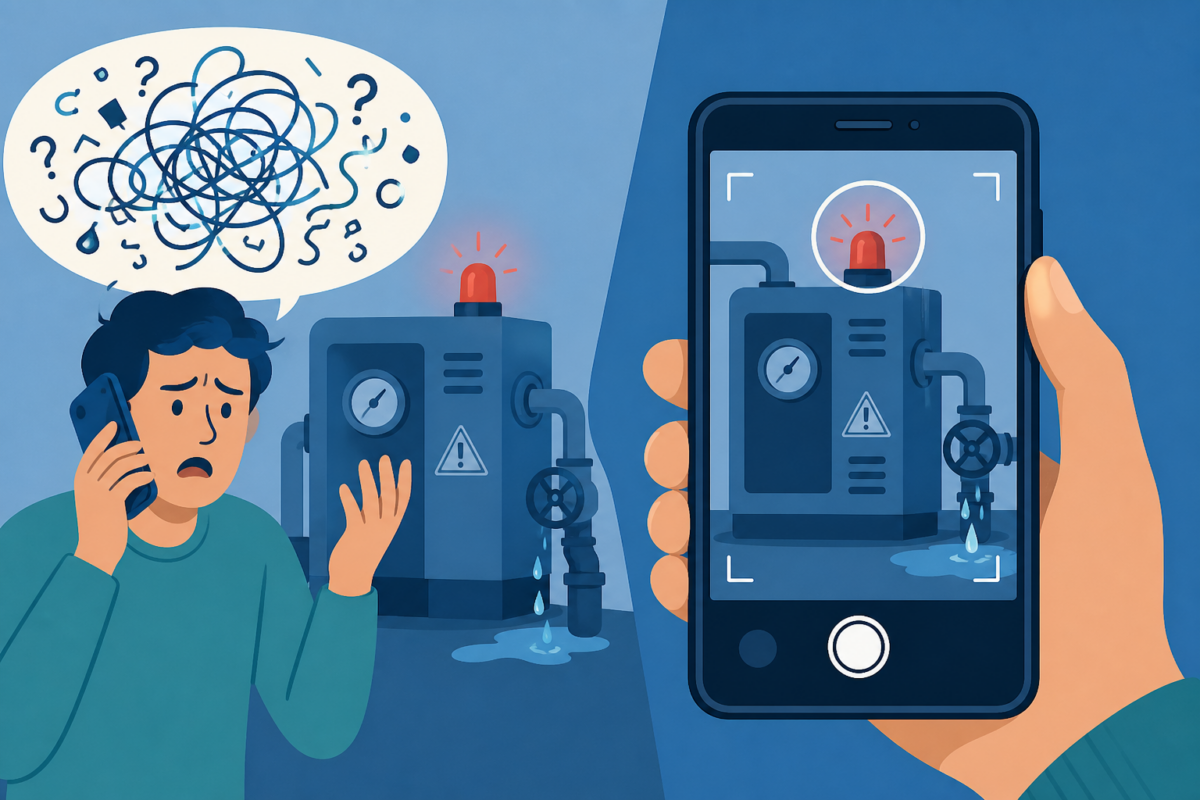
Ask any support leader where their cost lives and they’ll point at ticket volume, handle time, maybe truck rolls. Wrong layer. The most expensive case in your queue isn’t the complicated one. It’s the one where the customer is standing in front of the problem and cannot tell you what they’re looking at.
“There’s a light blinking.” Which light? “The red one, near the thing that hums.” Is the valve on the left or the right of the intake? “I don’t know what a valve looks like.” Twenty minutes in, your agent is playing verbal Pictionary with someone who has never seen the inside of the unit they bought. And every guess compounds. A misdiagnosis, a wrong part shipped, a second call, a technician dispatched to fix something a firmware reset would have solved.
That case didn’t cost you one contact. In fact, it cost you four — plus a dispatch, plus a customer who now tells people your product is flaky. And the root cause was never the product. It was translation failure.
Description is a skill your customers don’t have
Support economics quietly assume the customer can convert a physical situation into accurate language. That assumption fails constantly, and it fails hardest exactly where cases are most expensive: hardware, appliances, medical devices, networking gear, industrial equipment. Of course, the customer isn’t stupid. They just don’t have your vocabulary. They don’t know “coupling” from “gasket” and can’t tell an amber status LED from a fault LED. So they will confidently describe a loose HDMI cable as “the internet is broken.”
Human-factors researchers have a name for the gap between what an expert sees and what a novice can articulate. But you don’t need the literature. Listen to ten calls about physical products. Count how many minutes go to establishing what the problem is instead of solving it. That’s your hidden line item. Misdescription drives repeat contacts. In turn, repeat contacts are where cost-per-resolution goes to die. Every downstream failure mode traces back to the same upstream event — the wrong-part RMA, the no-fault-found dispatch, the escalation to tier two. We asked a customer to be a sensor, and they failed.
The AI stack inherits the same ceiling
Here’s what makes this urgent in 2026: the entire AI support wave rests on the same broken assumption.
Last week Encore AI raised a $30 million Series A to train voice agents on a company’s best human customer interactions. The thesis: mine your elite reps’ verbal patterns, and the AI performs like your elite reps. It’s a reasonable bet — for problems that are fully expressible in words. Account questions, billing disputes, policy lookups. Text-shaped problems.
But an AI agent trained on the world’s best support conversations still receives its input through the customer’s mouth. If the customer can’t describe the blinking light, the model is doing elite-level reasoning on garbage input. You’ve built a brilliant listener for a speaker who can’t speak. The bottleneck was never the agent’s language skill. It’s the customer’s.
This is one underrated reason so many AI deployments stall. IDC research surfaced last week found that 88% of enterprise AI agent proofs-of-concept never reach broad production. For every 33 pilots launched, roughly four go live. Cognizant launched an entire EMEA AI unit to attack that failure rate. The post-mortems cite integration and governance, and sure. But watch where agentic support actually breaks in the field: it breaks at intake. The pilot demos beautifully on clean, well-described tickets. Then it collapses when a real customer says “it’s making a weird noise near the back part.”
Garbage in, garbage out didn’t get repealed because the model got bigger.
The expensive cases cluster where words fail
Segment your cases by resolution cost and a pattern emerges. Cheap cases are informational — the answer exists in a knowledge base and the question was easy to state. By contrast, expensive cases are physical — something in the real world is in a state nobody can name. The correlation isn’t with product complexity. It’s with describability.
I’ve argued before that pay-per-resolution pricing only makes sense if your problems are text-shaped. The same lens applies to your cost structure. Your P&L doesn’t split cases into easy and hard. It splits them into cases where language worked and cases where it didn’t. And the first pile subsidizes the second.
The dispatch data backs this up. A meaningful share of field visits end in “no fault found” or a five-minute fix — a switch flipped, a cable reseated. Those trucks didn’t roll because the fix was hard. They rolled because nobody could confirm, remotely, in words, what state the equipment was in. The truck is a $200-plus admission that the phone call failed as an information channel.
Stop asking customers to be translators
The fix is not better scripts, more patient agents, or a voice model with warmer prosody. The fix is removing the translation step entirely. After all, the customer holds a camera in their hand. So let the agent — human or AI — see what the customer sees.
The moment video enters the interaction, the whole failure chain collapses. “The red light near the thing that hums” becomes a two-second glance at the panel. A diagnostic that took twenty minutes of interrogation now takes thirty seconds of looking. And the wrong-part shipment doesn’t happen, because the agent reads the model number off the label instead of trusting the customer’s memory. And your AI stack gets what it actually needed all along: ground truth instead of a novice’s paraphrase of it. I’ve written about why visual-first should be the default decision, not the escalation of last resort. This is the economic core of that argument.
None of this means voice AI is a dead end. Encore’s bet on elite verbal patterns will pay off in every domain where the problem fits in a sentence. But if your product exists in the physical world, the cases that don’t fit in a sentence set your cost curve. And no amount of language skill on your side of the call fixes a description failure on theirs.
Your most expensive customer isn’t the angry one. It’s the one standing three feet from the answer, trying to describe it. Stop making them try. Just look.