
Your Senior Tech Is Retiring and No LLM Learned What They Know

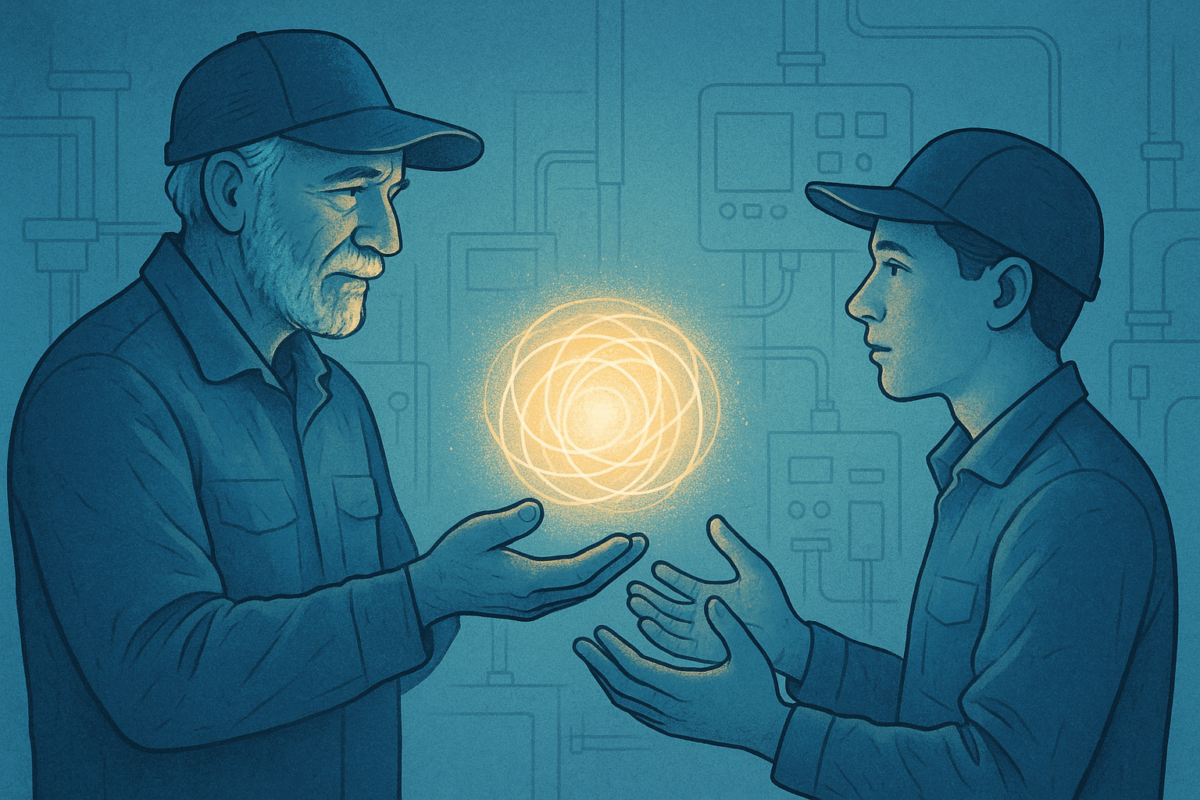
The baby boomer retirement wave is not a coming crisis. It’s a current one. Between 2023 and 2030, roughly 4.5 million baby boomers per year will reach retirement age in the United States. In the skilled trades and technical services sector, the numbers are bleaker: the National Elevator Industry Educational Program projects a 40% technician shortage within the next decade. HVAC, electrical, telecommunications, industrial equipment — the same story everywhere. Senior techs are walking out, and field technician knowledge transfer — the systematic effort to capture and pass on what they know — has never been more urgent.
Here’s what makes this worse than a headcount problem: the knowledge walking out with them was never written down — which is precisely what makes field technician knowledge transfer so hard to solve.
The Tacit Knowledge Problem Nobody Wants to Talk About
There’s a category of knowledge that exists in skilled work that can’t be extracted with an exit interview or a process document. Researchers call it “tacit knowledge” — the stuff you can’t teach by describing it. It lives in fingertips, in the way a sound changes before a motor fails, in a glance at a condenser coil that tells an experienced tech something is wrong before any diagnostic tool fires an alarm.
A 30-year HVAC tech can walk into a mechanical room and know something is off within 90 seconds. Ask them how, and they’ll say “I’ve just seen it before.” That’s not an unhelpful answer — that’s the most accurate description of tacit knowledge possible. It’s pattern recognition compressed by decades of physical exposure. You can’t transcribe it. You can’t Google it. And critically: you can’t train an LLM on it.
Consequently, this is the knowledge gap that’s about to hollow out entire industries.
AI Was Trained on Documentation. Technicians Don’t Document.
The AI optimism sweeping the enterprise world rests on a flawed assumption: that the knowledge we need to preserve and transmit is already somewhere in digital form. For white-collar work — legal, financial, administrative — that’s often true. There are emails, memos, filings, contracts. Language models trained on text can genuinely accelerate that kind of work.
Field technicians don’t work that way. A senior tech’s diagnostic process isn’t in a ticket. It’s not in a service log. The notes they leave are shorthand: “replaced capacitor, unit running.” That tells you nothing about how they identified the problem, why they ruled out the compressor, what they heard or felt or saw that pointed them at the right component on the first try.
No LLM trained on field service documentation learned that. The documentation doesn’t contain it. The knowledge lives in the person — embodied, physical, experiential. When they retire, it’s gone.
Research on knowledge transfer consistently shows that tacit knowledge is the hardest to transfer and the most valuable to retain. A 2020 study from the MIT Sloan Management Review found that organizations routinely underestimate the tacit knowledge component by a factor of three — they think they’ve captured 80% of what a departing expert knows, and they’ve actually captured 20%. The gap is always in the unspoken, unwritten, physical-judgment layer.
Junior Techs Are Being Set Up to Fail
The training programs being spun up to address the tech shortage are mostly producing juniors who can pass a certification exam. That’s not the same thing as being able to troubleshoot in the field under pressure.
Working alongside experienced technicians filled the gap between certified and competent — or it used to. Specifically, the apprenticeship model was built for exactly this. You watched the senior tech work. You absorbed judgment by proximity. Over thousands of hours, their pattern recognition became yours.
That model is collapsing under the math. As a result, there aren’t enough senior techs to mentor the volume of juniors entering the field. And the ones who remain are being deployed on jobs, not teaching. Time with a seasoned tech is getting rare, then rarer, then gone. That scarcity turns field technician knowledge transfer into a crisis that compounds with every retirement.
What fills the gap instead? Dispatch systems send a junior out alone. They call back to the office. Someone reads them a troubleshooting flowchart. They go back and forth on the phone, describing what they’re seeing to someone who can’t see it. The senior tech — if there’s one available remotely — is trying to diagnose from descriptions.
That’s a broken feedback loop. You can’t transfer visual judgment over voice.
Field Technician Knowledge Transfer Has to Be Real-Time and Visual
This is where the framing needs to shift. The fundamental problem, therefore, isn’t documentation — it’s transmission. You can’t get tacit knowledge into a database because it was never in a database. But you can transmit it in real time, from person to person, through shared visual context.
That’s exactly what tools like Viewabo are designed for. A junior tech in the field opens a live video session with a remote senior. The senior sees exactly what the junior sees — the equipment, the wiring, the anomalies — and can guide them in real time. Not from a flowchart. Not from a description. From the same visual information they’d be using if they were standing in the room.
Moreover, this does something that documentation can’t: it creates a live transfer loop. The junior’s hands, the senior’s eyes and judgment. The senior says “pan left — see that? That’s the sign” and the junior sees it. That moment of recognition is knowledge transfer happening in the way tacit knowledge actually transfers: through shared perception, not through text.
And here’s the part that gets overlooked: every one of those sessions is a capture opportunity. The visual evidence, the diagnostic sequence, the decision points — you can record them, review them, and build them into training. Over hundreds of sessions, you start to build an institutional library of real field knowledge, not procedural documentation.
The Clock Is Running
Meanwhile, the retirement wave isn’t slowing down. The Bureau of Labor Statistics puts the median age of HVAC technicians at 43 — meaning a significant portion of the experienced workforce is within 15 years of retirement. In electrical and telecommunications infrastructure, the demographics skew older. The window to capture and transmit this knowledge is measured in years, not decades.
To be fair, AI will help with some things. It’ll get better at parsing service history, predicting component failure, optimizing dispatch. But it won’t fill the experiential gap. It can’t feel a vibration. No algorithm captures the harmonic that signals bearing wear before it shows up in the data. It can’t read the subtle visual tells that an experienced eye catches in two seconds.
The technicians who carry that knowledge are retiring. The only question is whether your organization creates the conditions to transmit it before they go — or watches it walk out the door.
Don’t Wait for the Exit Interview
Exit interviews don’t capture tacit knowledge. Knowledge management consultants don’t capture tacit knowledge. What captures it is putting junior techs in the field with access to senior expertise — live, visual, in the moment — so knowledge passes through direct experience rather than documentation.
If you’re in field service and you’re watching your senior bench thin out, the question isn’t whether to address this. The question is whether you’re building the infrastructure to make every remaining senior tech’s expertise accessible at scale before it’s gone. That means live video support. It means junior-senior pairing on complex jobs. It means treating every field session as both a service delivery event and a knowledge transfer opportunity.
The LLMs can handle the documentation. You need a plan for everything that was never documented.
Viewabo provides live visual support tools for field service teams. See how it works at viewabo.com.