
Gartner Says 40% of Agentic AI Support Projects Will Be Cancelled. They All Have One Thing in Common.

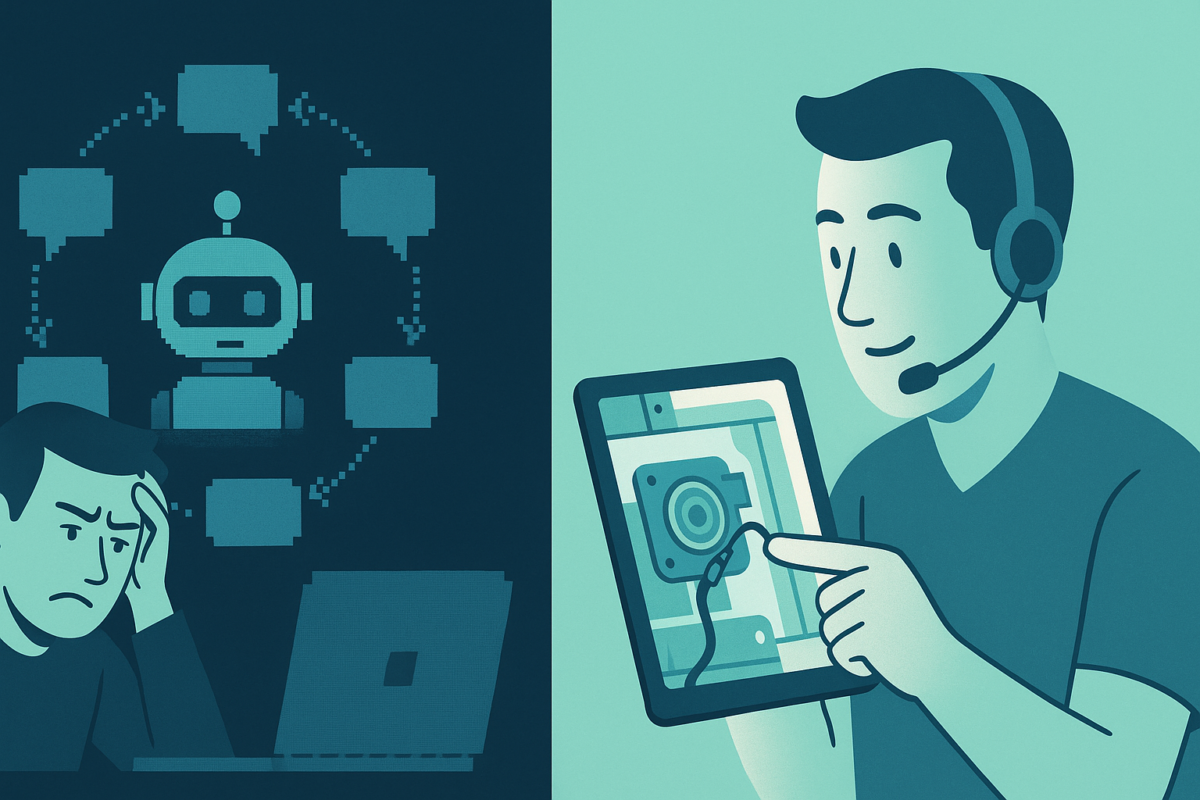
Gartner just dropped a prediction that should make every VP of Customer Service pause: more than 40% of agentic AI support projects will fail by 2027, casualties of unclear ROI. At the same time, a new study found that customers are so frustrated with AI agents they’re screaming “Human!” to escape — yet those same customers said they’d embrace AI with open arms if it resolved their issue 9 times out of 10.
That’s not a contradiction. That’s a diagnosis.
The problem isn’t AI. The problem is what organizations are asking AI to do.
Deflection Is Not Resolution
Here’s the dirty secret behind most AI support deployments: they were never really designed to solve problems. The goal was ticket volume reduction. The brief from the CX org sounds something like: “Use AI to handle the easy stuff so humans don’t have to.” And the vendors sold exactly that — intelligent routing, automated FAQs, conversational deflection flows.
This worked beautifully on paper. And then customers actually used it.
A chatbot can tell someone how to reset a password. It can explain a return policy. It can confirm a shipping date. But the moment a customer has a physical product that isn’t working right — a device, a piece of hardware, an appliance, a piece of field equipment — text-based AI hits a wall. The bot doesn’t know what the product looks like. It doesn’t know what state it’s in. It can’t see the blinking error light, the misrouted cable, the cracked housing, the installation mistake that’s three inches to the left of where the customer is describing.
So the bot asks for more information. The customer provides it. Another clarifying question comes back. The customer types harder, the bot loops again — until finally the customer screams “Human!” and the ticket gets escalated anyway — except now it’s an angry escalation, 15 minutes later, with a customer who’s been thoroughly convinced that your company doesn’t care about them.
The ROI math doesn’t work because deflection isn’t resolution. You just made a slower, worse version of the escalation you were trying to avoid.
The 9/10 Standard Customers Are Willing to Accept
The customer research finding is worth sitting with: 85% of customers said they’d be happy using AI support if it resolved their issue 9 out of 10 times.
Read that again. Customers aren’t anti-AI. They’re anti-failure. They want help, and they genuinely don’t care who — or what — helps them, as long as it works.
That 9/10 bar isn’t actually that hard to hit for the right problem set. But it’s nearly impossible for AI operating blind on a complex physical product interaction. The first-contact resolution rate for text-only support on hardware issues hovers somewhere around 40–50% on a good day. That’s not a failure of the AI model. That’s a failure of the input. You can’t resolve what you can’t see.
Where Agentic AI Actually Breaks Down
The companies whose agentic AI support projects are facing cancellation aren’t failing because they chose the wrong LLM or wrote bad prompts. They’re failing because they’re applying AI to a workflow that doesn’t have enough information.
Agentic AI is powerful when it has rich, structured context to act on: account history, known product configurations, verified states, unambiguous data. It falls apart when it’s asked to interpret a customer’s fuzzy description of a physical problem they don’t fully understand themselves. “The thing isn’t working” isn’t a knowledge retrieval problem. It’s a perception problem.
The gap is widest precisely where physical products and field service live. Industrial equipment. Consumer electronics. Smart home devices. Medical devices. Any category where the support agent needs to see what’s happening to actually help. These are the categories where AI deflection fails hardest and fastest, and where the canceled projects are most concentrated.
What Resolution Actually Requires
If agentic AI support is going to hit that 9/10 standard, it needs to do what a good human technician does: look at the problem.
This is where visual support changes the equation entirely. When a customer can show a support agent — human or AI-augmented — exactly what they’re looking at via live video, the resolution rate jumps dramatically. Not because video is magic, but because the information gap closes. The agent sees the error, the product state, and what the customer is doing. The diagnostic path compresses from 15 minutes of text exchange to 90 seconds of seeing and fixing.
Viewabo is built on this premise: the fastest path to resolution is seeing what the customer sees. Live video support that works without app downloads, without setup friction, without making an already-frustrated customer jump through hoops. Just a link that opens the camera, and a support agent who can actually help now.
That’s not a feature. That’s the foundation. And it’s what distinguishes support infrastructure that generates ROI from support infrastructure that generates Gartner cancellation statistics.
The Projects That Will Survive
The agentic AI support projects that survive into 2028 will share a common trait: they’ll be built on a foundation of rich visual and contextual information, not just text. The AI agents running those workflows will have something to actually work with. They’ll see a video feed, have annotated images, and work with structured visual inspection data that grounds their reasoning in reality.
The canceled projects will be the ones that tried to build intelligence on insufficient inputs, used AI to deflect rather than resolve, and discovered too late that a bad AI interaction is worse for customer retention than no AI at all.
Gartner’s 40% forecast isn’t pessimism. It’s a prediction about the projects that skipped the hard part. The hard part isn’t the AI. The hard part is making sure the AI can see.