
Product Manuals Cannot See the Customer’s Starting Point

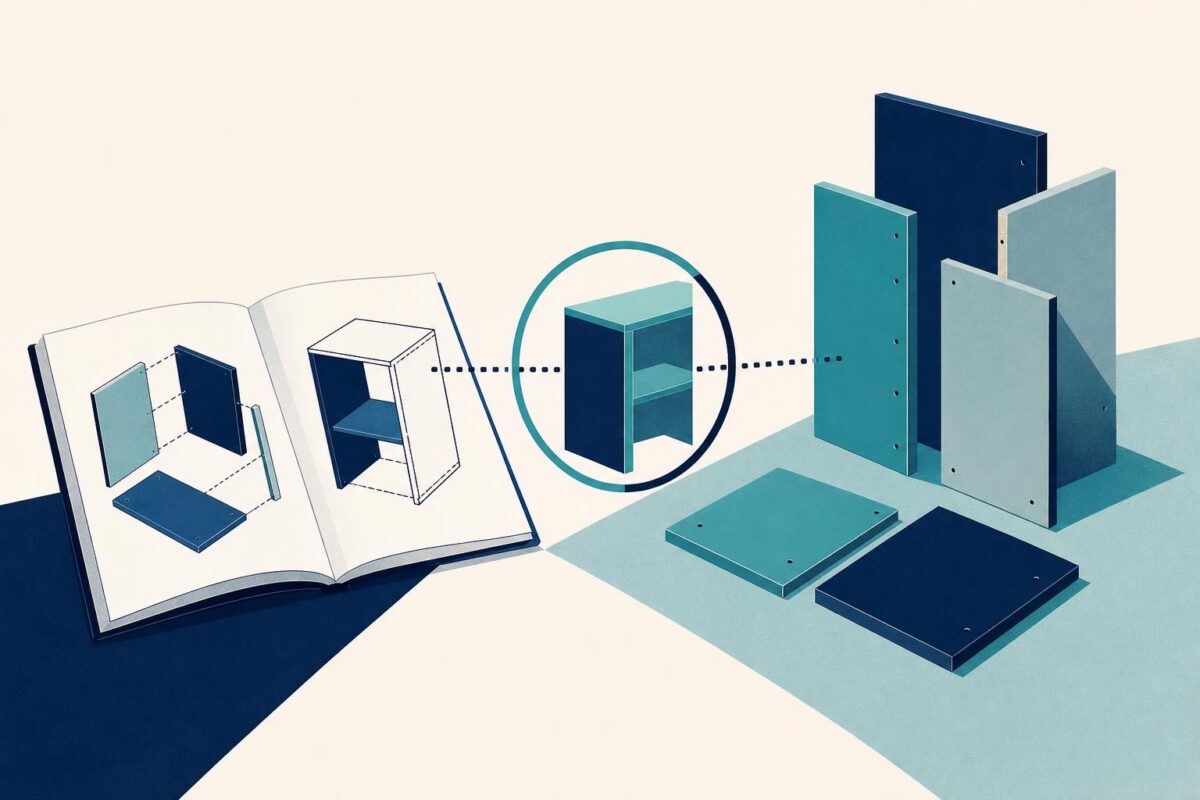
Product manual support can provide accurate instructions and still fail the customer. The manual describes the intended starting point. The customer may be several steps away from it without realizing the difference. Repeating the same instruction does not close that gap.
This is why visual guidance can be a useful companion to documentation. The goal is not to replace a clear manual with a conversation. It is to establish whether the real product, parts, and situation match the instruction the team is about to recommend.
The missing first step in product manual support
Consider a hypothetical customer assembling a flat-pack storage unit. The manual says to attach the next panel. The customer says the holes do not line up. Both statements can be true if an earlier panel faces the wrong direction.
The instruction at the current step may be perfectly written. The problem lies in an assumption carried forward from a previous step. If support only repeats the current page, the customer may try harder to make an incompatible arrangement fit.
A useful support response therefore starts before the disputed instruction. Confirm the item, the stage of assembly, and the relationship between the parts already in place. The exact point of confusion matters more than whether the customer has read the document.
Make documentation task-specific
Nielsen Norman Group’s December 2020 guidance on help and documentation emphasizes searchable, task-focused help with concrete steps. For physical support, our recommendation is to pair those steps with a check that the customer’s starting condition actually matches them.
Instead of sending an entire manual, identify the relevant section and explain why it applies. If there are similar-looking variants, confirm the correct document before asking the customer to follow it. The agent should not make document selection another hidden diagnostic task.
Also clarify what success looks like at the end of the step. A customer may interpret complete as having used the listed parts, while the manual assumes a particular orientation or fit. An observable checkpoint reduces that ambiguity.
Do not interpret confusion as inattention
A customer can study a diagram carefully and still map it incorrectly to the object in front of them. Perspective changes, mirrored shapes, and unfamiliar names all create opportunities for honest misunderstanding. An instruction to look more closely may not address the actual difficulty.
Ask the customer which part of the illustration they believe matches their setup. Their answer can reveal the mismatch without assigning blame. If language becomes cumbersome, a shared view can establish the relationship more directly.
In the storage-unit example, the question is not whether the customer followed directions. It is whether both people agree on which surface and edge the diagram represents. That is a narrower and more useful problem.
Use visual guidance to locate the divergence
Begin with the overall assembly rather than a close-up of the stubborn connection. The apparent problem may be downstream from an earlier choice. Then work back to the last stage where the customer felt confident that the product matched the instructions.
Inspect only what is appropriate and safely accessible. Do not ask a customer to force a joint, support a heavy object unsafely, or undo an assembly that requires trained help. If the condition calls for replacement parts or hands-on assistance, make that the next step.
Once the team identifies the relevant difference, return to the approved instruction. Visual understanding should help the customer use the documentation, not introduce an improvised procedure that conflicts with it.
Let the manual carry repeatable knowledge
Some teams respond to difficult cases by explaining everything verbally. That can leave the customer without a usable reference after the call. It can also encourage agents to deliver slightly different versions of the same procedure.
Instead, use the live interaction to establish context, then connect it to the written guidance. State which section now applies and what the customer should check before proceeding. Keep the final explanation short enough to revisit later.
If the same misunderstanding recurs across cases, review the manual itself. The repeated need for explanation may indicate a missing perspective, unclear label, or weak checkpoint. Visual support should generate learning about documentation, not excuse a confusing document indefinitely.
Where Viewabo complements the manual
Viewabo fits support situations where seeing the physical product helps people reach a shared understanding. For an uncertain starting point, this approach may fit better than extending product manual support with another copy of the same page.
The value is contextual guidance, not a claim that every assembly or repair belongs in a remote session. Customers may prefer written instructions, and some tasks require qualified hands-on help. Preserve both paths.
Our earlier article on video for customer support provides the broader reasoning. The manual-specific lesson is that correct information becomes useful only when the customer can connect it to the object they actually have.
Check understanding before declaring completion
At the end of a support interaction, ask the customer to identify the next appropriate step and its expected result. That is more informative than asking whether everything makes sense. It reveals whether the common reference point survived the explanation.
Product manual support works best when documentation and observation reinforce each other. Let the manual explain the repeatable procedure. Use shared visual context to establish where this customer should enter it, and stop when the task exceeds what remote guidance can responsibly resolve.