
Skill-Based Dispatch Needs a Remote Expert Layer

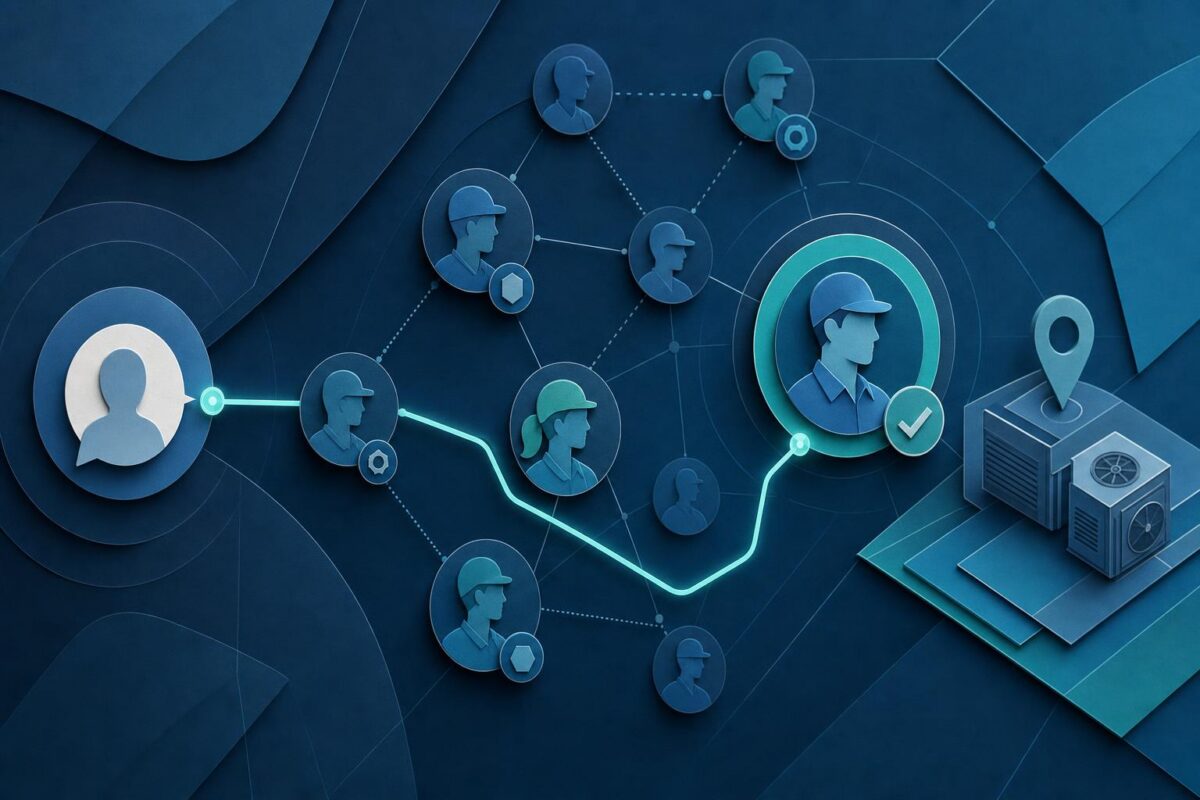
The uncomfortable truth about skill-based dispatch is that most companies still confuse a technician record with service capacity. They document certifications, products, territories, and years of experience. Then they assume the right expertise is available only when the right person can drive to the job.
That assumption makes every scarce skill more expensive than it needs to be.
A refrigeration specialist may be booked across town. A senior controls technician may be two states away. Meanwhile, a capable general technician may already be standing beside the equipment. The service organization sees a mismatch and schedules another visit.
The customer sees a company that sent the wrong person.
Skill-Based Dispatch Still Assumes Expertise Must Travel
A September 30 FSM News article on technician skill data makes an important distinction: availability is not capacity. Twenty technicians on the schedule do not create twenty interchangeable units of service.
Some people hold specific certifications. Others know a product family deeply. Certain customer sites require clearance. Therefore, the closest technician may not be the person most likely to complete the work.
That is exactly right. However, most implementations of skill-based dispatch stop one step too early.
They ask, “Which technician has the required skill?” Then they assign the job to that person, even if the expert must spend half a day traveling.
A better question is, “Which skills must be physically present, and which skills can be delivered remotely?”
That distinction changes the schedule. Hands may need to be on site. Expert judgment often does not.
A Skills Matrix Can Be Accurate and Operationally Wrong
Consider a junior technician facing an unfamiliar control board. The company’s skills database correctly shows that she has not serviced that model before. It also shows that a senior technician has completed dozens of repairs on it.
Traditional skill-based dispatch treats those facts as an assignment rule. Send the senior person.
Yet the real constraint may be narrower. The junior technician can open the panel safely, take measurements, replace a component, and test the result. What she lacks is pattern recognition at one diagnostic decision.
Sending the senior technician moves an entire person to deliver ten minutes of judgment.
Instead, the junior technician can start a live visual session. The senior expert sees the board, asks for a closer view, and watches the measurements. As a result, the expert can identify the likely fault and guide the repair without leaving the current location.
The skills database was accurate. The operating model was wrong.
It treated expertise as something stored inside a truck.
Remote Expert Coverage Changes the Capacity Model
Remote support should not sit outside the dispatch process as an emergency fallback. It should appear directly inside the capacity model.
If a technician can reach a qualified expert during the service window, that access changes which jobs the technician can complete. Therefore, the schedule should recognize both local hands and remote judgment before declaring a skill shortage.
This does not mean pretending every technician can do every job. Safety rules, licensing, customer requirements, and physical complexity still matter. Some work must wait for a specific qualified person.
However, many service calls do not fail because the assigned technician lacks all the required capability. They fail because one uncertain decision blocks progress.
Visual access lets an expert inspect the actual situation instead of interpreting a rushed phone description. The expert can see the component, installation, readings, and surrounding conditions. Consequently, guidance becomes specific enough to support action.
That turns skill-based dispatch from a search for one perfect technician into a plan for assembling the right capability around the job.
Record More Than Certifications
Most skills databases describe individuals. Stronger ones should also describe how expertise can move through the organization.
First, record who can perform each task independently. This remains the foundation because authorization and demonstrated competence matter.
Next, record who can perform the task with remote guidance. That category is often missing, even though it may represent a large share of the workforce.
Also record who can provide expert guidance, for which equipment, and during which windows. A senior technician with two hours reserved for remote support may unlock more completed work than the same person driving to one distant site.
Finally, capture the outcome. Did the remote session resolve the job? Did it prevent a second visit? Did the technician need the same help again?
In practice, those outcomes should update training plans and future dispatch decisions. A technician who completes several guided repairs may be ready for independent work. Meanwhile, repeated escalation on one product may reveal a broader training gap.
Stop Measuring Capacity in Bodies
Headcount is easy to count. Usable capability is harder.
That is why service organizations keep adding people while the same specialist bottlenecks remain. They hired more hands, but they did not change how judgment reaches the field.
We recently argued that a field service job description exposes whether a company moves expertise or multiplies it. The same test applies to the dispatch board.
When a difficult ticket arrives, does the system search for one rare person who can own the entire visit? Or can it combine a nearby technician with an available expert who joins visually at the decision point?
The second model protects specialist time. It also gives less experienced technicians a practical path to grow through real work.
Most importantly, it improves the customer outcome. The customer gets a prepared technician, quicker access to deeper expertise, and a better chance of resolution during the first visit.
Good skill-based dispatch should not merely identify where expertise sits. It should make that expertise reachable.
If the skills matrix cannot represent remote expert coverage, it is not measuring the team’s capacity. It is measuring the mileage required to use it.