
Sony Visual Support: Understand the Creator’s Camera Setup

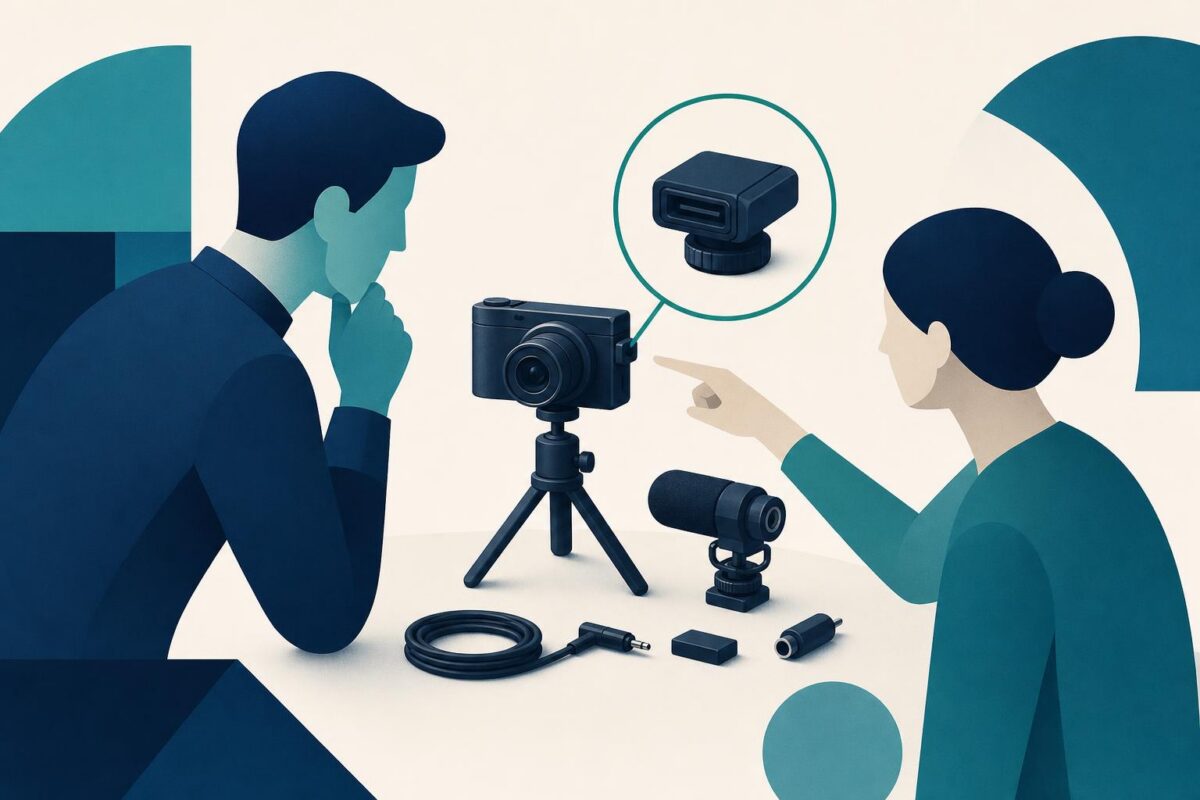
Sony visual support is a strong prospective fit when a creator’s camera question is really a setup question. The customer may describe the result of a recording, while the support team has no view of the camera, attached accessories, or arrangement used to produce it. That missing context can make even a simple explanation difficult.
Viewabo could help the customer and agent discuss the physical setup together before choosing the next action. This is an independent company-fit analysis, not a claim of a Sony deployment or endorsement.
A creator brings an intended recording task
Sony’s May 2020 ZV-1 announcement presents a compact camera in the context of video creation. The relevant support lesson is that customers judge equipment through a task: recording themselves, demonstrating an object, or creating another intended shot.
The digital camera support workflow separates the intended image from focus, setup, and possible equipment faults.
The intake should therefore begin with the desired result. Ask what the customer wanted to capture and what happened instead. A framing concern, an accessory question, and a recording failure should not collapse into a single camera-not-working label.
For example, a creator may have changed the physical setup shortly before noticing a problem. That sequence deserves investigation, but does not prove the new accessory caused it. Preserve the timeline as evidence rather than jumping from correlation to diagnosis.
Establish the configuration without turning support into a shoot
An agent could ask the customer to show the camera and accessible accessories while everything is safely at rest. Confirm the relevant product identity and which pieces the customer is using. The purpose is to establish the configuration, not to ask for a polished demonstration.
A small tripod, an external accessory, or a mounting choice can affect which approved guidance is relevant. Those observations should direct the agent toward the correct documentation. Similar-looking connectors or accessories do not establish compatibility.
The support record should distinguish the current setup from the setup used when the issue occurred. A customer may have already removed or changed something. Without that distinction, the agent can end up investigating a configuration that never produced the reported result.
Where Sony visual support could improve accessory handoffs
A creator may buy a camera and accessories through different channels. When a question crosses those boundaries, the customer should not have to translate technical assumptions between suppliers. A clear statement of the assembled setup gives the next team a better starting point.
Record the identified items, the intended recording activity, and the observed behavior. If an accessory’s identity or compatibility remains unconfirmed, state that plainly. The next specialist can then investigate a specific uncertainty rather than repeat a broad intake.
Viewabo would fit the shared-communication portion of that handoff. This proposal does not depend on remote camera control, media analysis, or any claimed integration. It concerns people understanding the same physical arrangement before giving advice.
Separate creative expectations from service evidence
A customer who dislikes a recording result still deserves a precise explanation. The support team should first understand what they consider wrong. Some questions may call for approved operating guidance; others may require a service assessment. The difference must follow evidence, not an assumption about the customer’s skill.
A visual conversation cannot independently establish every image-quality or audio concern. Nor can it reveal all internal conditions. When a proper diagnostic process or sample review is needed, the agent should explain that next step and use the appropriate channel.
The aim is not to dismiss creative expectations as user error. It is to preserve the original concern and choose a support path that can actually address it. A customer should leave knowing what the team understands and what remains unresolved.
Protect equipment and private creative work
Do not ask a customer to dismantle a camera, touch delicate internal surfaces, or operate a precarious rig for a better view. Keep the conversation within approved user actions. A damaged or unsafe arrangement needs the appropriate service response.
Creative work may also contain private people, client material, or unreleased content. An agent should request only what the decision requires. A non-sensitive setup view may be enough before any separate process for reviewing media becomes necessary.
If a test is appropriate, explain what it is meant to establish. Avoid repeated recording attempts that consume the customer’s time without narrowing the question. Each step should have a clear purpose and an outcome the team can interpret.
Evaluate a narrow creator-support queue
A Sony visual support pilot could begin with setup and accessory-identification questions for a defined camera family. Review whether agents establish the correct configuration, whether transfers retain that information, and whether the customer can complete the agreed next action.
Include repeat contacts and unresolved concerns in the review. A confident explanation is not a verified outcome. Likewise, a service referral can be appropriate when the visual conversation establishes that another process is needed.
The case for Sony is the connection between a creator’s task and the physical equipment used to perform it. The broader case for video in customer support supports that principle. Viewabo is worth evaluating when seeing the setup helps the team ask a more precise question before it recommends a solution.