
Why You Should Treat AI Agents Like Employees

For most of my career, I thought about software the same way many founders still do today. Software was a tool. People were the ones doing the work. If you wanted to move faster, you would hire more people. If you wanted better results, you would hire more experienced people. Software helped, but it never replaced the need for a team.
Over time, that belief stopped being true.
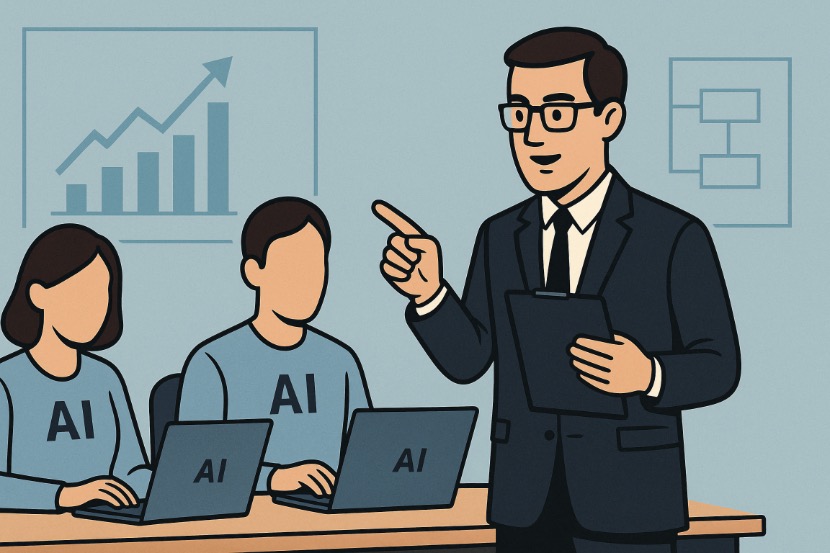
After using many AI tools inside my company, I reached a clear conclusion. The best way to work with AI, and AI agents in particular, is to treat it like an employee. Not a tool. Not an assistant. An actual worker responsible for outcomes.
Once you adopt this mindset, everything changes.
Instead of managing humans who use software, you start managing AI agents that do the work directly. In many cases, these AI agents perform faster and better than the human teams they replace. This shift is already underway, and founders who see it early are moving much more quickly than those who do not.
The Old Model of Software Is Broken
For decades, every wave of software promised higher productivity. Email, spreadsheets, CRMs, project management tools, and cloud infrastructure all followed the same model. Humans stayed at the center, and software remained on the side.
However, AI completely breaks that model.
Modern AI systems plan tasks, execute work, evaluate results, and improve over time. Calling them tools does not reflect what they actually do. A more accurate way to think about AI is as an employee who owns a job and is judged by results.
When I started treating AI like an employee, my expectations changed. I stopped asking what features a tool had and started asking what outcomes the AI was responsible for. I was no longer buying software to help me work; I was hiring digital workers to take ownership of entire functions.
This shift also raised uncomfortable questions. Why did things take so long before, and why was the quality inconsistent? Why were deadlines often missed? In many cases, the answer was simple. We accepted those limits because we thought they were normal. They are not anymore.
Managing AI Agents Instead of Managing People
The most significant change here is not technical. It is psychological.
Most founders were trained to manage people. Hiring, onboarding, alignment, and conflict resolution took up vast amounts of time. Delays were common, and excuses were expected.
Managing AI agents feels different.
AI agents do not get tired. They do not protect their calendar, they do not pad estimates, and they do not lose motivation. They execute the task you give them.
Because of this, the way you work changes. You stop thinking in a straight line and start working in parallel. Instead of doing one task at a time, you run multiple tasks simultaneously. Instead of debating whether something is worth testing, you test it.
As a result, the founder’s role changes. You stop managing people and start orchestrating systems. You design workflows where multiple AI agents work at the same time. This is why tiny teams can now achieve what used to require entire departments.
You Can and Should Fire AI Agents
Treating AI like an employee also means holding it accountable.
If an AI agent is not performing, you can and should fire it.
This is one of the most significant advantages of working with AI. There are no long-term improvement plans and no emotional conversations. If an AI agent does not deliver good results, you replace it.
Replacing an AI agent is easy. Competition in AI is intense, and models continue to improve. You can switch tools, models, prompts, or workflows in hours or days. This creates a performance-driven environment where quality improves quickly, and standards stay high.
The End of Large Software Teams
There is a larger shift happening. The era of needing large teams to build and ship software is ending.
For years, technical founders depended heavily on software engineers. If engineering said something would take six months, the discussion usually stopped. Slow delivery became normal. Missed deadlines were explained with complexity or dependencies.
AI agents change that dynamic.
When AI can write code, refactor it, test it, and debug it in parallel, speed becomes the default. As a founder, you begin to question why things ever moved so slowly. Much of the friction we accepted before came from the old way of working.
This does not mean human engineers disappear. Judgment, architecture, and experience still matter. What disappears is the monopoly on execution speed. A strong technical founder can now build and ship products alone with the help of AI agents.
Why Domain Knowledge Still Matters
AI agents do not eliminate the need to understand the work being done.
To get real value from AI agents, you need domain knowledge. You need to know what good output looks like and how to judge results. The difference today is that learning is much faster.
If you lack experience in a domain, AI can help you gain it quickly. You can ask questions, explore edge cases, and study best practices. You no longer need years of experience to get started; you just need curiosity and good judgment.
This creates a feedback loop. You learn enough to guide the AI. The AI produces work that improves your understanding. That improved understanding helps you guide the AI even better. Speed compounds.
Speed Is the Real Advantage of AI Agents
The real advantage of AI is not efficiency or cost savings. It is the speed of execution.
When experiments are cheap and fast, behavior changes. You stop overplanning and stop waiting for perfect information. You try things.
AI removes the mental friction that slows companies down. There are no more excuses for moving slowly. When you can run ten experiments in the time it used to take to plan one, momentum becomes normal.
Your Company Becomes a System of Experiments
Over time, your company stops feeling like a rigid organization and starts feeling like a system of experiments.
AI agents handle customer support, engineering, growth, design, data, recruiting, and finance. Humans focus on judgment, direction, and taste. Everything runs continuously and improves through feedback.
The company feels less like a machine and more like a living system.
The Type of Founder Who Wins in This Era
Not everyone will succeed in this environment.
This era rewards founders with high agency. People who act without waiting and take responsibility even when things are unclear. It rewards builders who prefer creating over discussing. It rewards comfort with chaos because AI systems fail and evolve constantly.
At the same time, an ego becomes a liability. Experimentation means failure, and you cannot take it personally. Confidence still matters, but it must be paired with humility. The best founders assume responsibility and quickly unlearn outdated beliefs.
Think Bigger Than Cost-Cutting
It is easy to frame AI as a way to cut costs. That thinking is too small.
AI agents should make you think bigger. Markets that once felt unreachable become possible. Ideas that once felt impractical become realistic. The real power of AI is expansion, not reduction.
The New Mental Model for Founders
Everything comes back to one mental shift. Stop treating AI like a tool. Start treating AI like an employee.
When you do that, your role changes. You stop doing the work, you design systems that do the work. You define outcomes, orchestrate agents, and set direction.
The future belongs to founders who make this shift early. The question is not whether this future arrives. The question is whether you will lead it or watch others pass you by at full speed.
Related Reading: