
Why Your Technicians Are Making Two Trips When One Should Be Enough

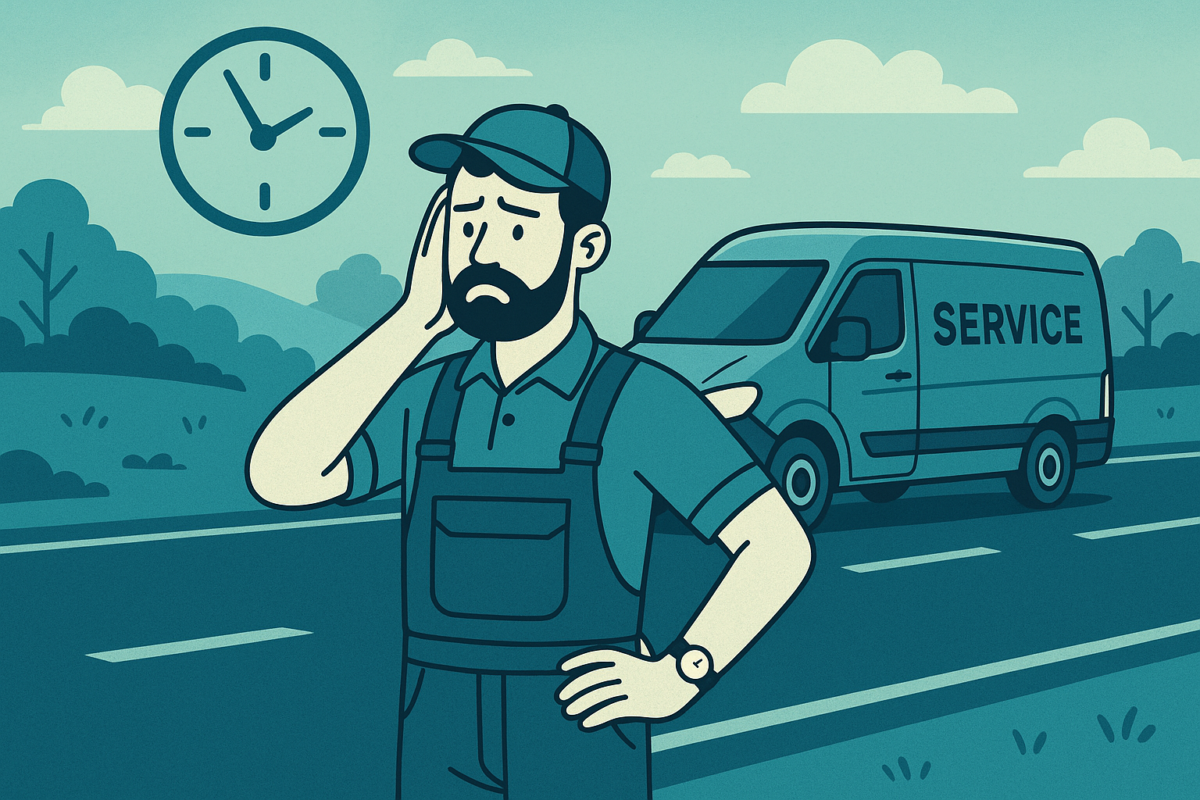
Furthermore, here’s a scenario every field service manager knows. This is especially relevant when thinking about reduce truck rolls remote support.
Additionally, a customer calls in: machine is down, error code flashing, production stopped. You dispatch a tech. Tech drives two hours. Tech arrives, looks at the machine, calls his supervisor, turns out he needs a different part, or a different tech with a different certification. He drives back empty-handed. You schedule a second dispatch. The customer’s production is stopped for another 24 hours.
In fact, you just spent $800 in labor and travel to make zero progress.
Also, this happens more than most service organizations admit. Industry data puts the average field service first-time fix rate between 74% and 78%. That means roughly one in four dispatches fails to solve the problem on the first visit.
Furthermore, and the cost per failed dispatch? When you factor in technician time, vehicle costs, fuel, and customer downtime: $200–$1,500 per unnecessary visit, depending on your geography and equipment type.
Furthermore, importantly, the math adds up fast.
The Real Reason Dispatches Fail: Understanding reduce truck rolls remote support
Moreover, it’s tempting to blame technicians. In reality, most first-time fix failures come down to information asymmetry, the tech showed up without knowing what they were actually dealing with.
The most common failure modes:
Wrong part dispatched. The tech was told “error code E4” over the phone. They brought the part that fixes E4. But when they arrived, the issue was actually the connector upstream of the component throwing E4. No part in the van fixes that.
Wrong tech dispatched. Field service scheduling is often based on geography, not capability match. The tech who lives closest to the customer isn’t always the one certified for that equipment model.
Problem disappears on arrival. Intermittent faults, common in industrial environments with temperature variation, vibration, or power fluctuations, often resolve themselves by the time a tech arrives. The tech can’t reproduce it. Customer calls again three days later.
Symptom vs. root cause confusion. Customers describe what they see, not what’s wrong. “It’s making a noise” or “the light is flashing” is not a diagnosis. Without actually seeing the problem, your team is triaging blind.
In addition, all four of these have the same fix: see the problem before you dispatch.
What Remote Visual Support Actually Does
Additionally, notably, remote visual support lets your support team (or a senior tech) open a live video session with the customer or an on-site technician before a truck leaves your depot.
In that 10-minute video call, your team can:
- See the exact error code or symptom, not a verbal description of it
- Confirm the part needed before the van is loaded
- Assess whether the issue requires on-site work at all, or if the customer can be walked through a fix remotely
- Identify the right tech certification required, so you schedule correctly from the start
- Annotate live video to guide the customer through safe pre-inspection steps
Indeed, the key operational shift: the diagnosis happens before dispatch, not after arrival.
Furthermore, for a lot of issues, the diagnosis reveals that no truck is needed at all, a firmware reset, a settings change, a customer-accessible component that needs cleaning. That’s a $0 resolution versus a $400 dispatch.
For issues that genuinely require on-site work, remote triage means your tech shows up knowing exactly what they’re dealing with, with the right parts, and resolves it on the first visit.
The first-visit resolution analysis explains why a repeat visit should not automatically be treated as evidence that the wrong technician was hired.
The Numbers: What First-Time Fix Rate Improvement Is Worth
Industry benchmarks from Aberdeen Group and Field Service News put it clearly:
- Top-performing field service organizations (>88% FTFR) earn 21% more in annual revenue than average performers
- Each 5-point improvement in FTFR reduces per-service-incident cost by an estimated 13%
- Customer satisfaction scores for resolved-on-first-visit incidents run 30–40% higher than multi-visit resolutions
If your team does 200 dispatches per month with a 75% first-time fix rate, you’re making 50 repeat visits. If remote visual triage can cut that in half, conservative for well-implemented programs, that’s 25 fewer truck rolls per month.
At $400 average cost per unnecessary dispatch, that’s $10,000/month in recovered cost. Every month.
Why “Send a Video” Doesn’t Work
Most teams try this informally first: “Can you record a video and send it to me?”
Three problems:
- Compressed video kills diagnostic quality. A WhatsApp video taken by a non-technical user is potato quality with auto-exposure adjustments that hide exactly the component you need to see.
- Static video misses intermittent issues. If the fault only appears when the machine is running, a pre-recorded clip won’t capture it. You need live video where you can ask the customer to cycle the machine, adjust something, move the camera.
- No annotation capability. The value isn’t just seeing the problem, it’s being able to point at things precisely. “The connector on the left of the blue relay, not the right.” Without annotation, you’re back to verbal descriptions.
Dedicated remote visual support tools exist specifically because “send me a video” fails these use cases.
How to Roll It Out Without a Six-Month IT Project
Additionally, this is where a lot of operations teams get stuck. They assume they need:
– A new platform installed on every technician’s phone
– IT sign-off and MDM integration
– A training program for field staff
– Enterprise licensing negotiations
In fact, modern remote visual support tools are browser-based. No app install. No account setup for the customer. You send a link. They tap it. Video starts.
Your support team handles 10 sessions before they even need formal training. Your technicians never need to touch it, this is the pre-dispatch triage step run by your support desk or technical team.
Rollout timeline for a serious field service team: two weeks, pilot on one product line, then expand.
The ROI Calculation for Your Team
Before you evaluate any tool, run this math:
- How many dispatches do you do per month?
- What’s your current first-time fix rate?
- What’s your average cost per dispatch (labor + vehicle + fuel)?
- What percentage of repeat dispatches do you think remote triage would catch?
In fact, conservative assumptions: 200 dispatches/month, 75% FTFR, $400/dispatch cost, 40% of repeat visits preventable by remote triage.
Monthly savings: 200 × 25% × 40% × $400 = $8,000/month
Annual savings: $96,000
Indeed, most field service-sized remote visual support subscriptions run under $500/month. The payback period is measured in days, not quarters.
The One Thing That Changes Everything
The field service organizations that have actually moved the needle on FTFR didn’t buy better scheduling software or hire more technicians. They started seeing the problem before they dispatched.
That’s it. That’s the unlock.
If your tech knows what they’re walking into before they leave the depot, almost every other optimization follows automatically: right parts, right tech, right tools, right time.
Remote visual support is the cheapest, fastest way to get there.
Viewabo is a browser-based remote visual support platform, no app download required. Customers tap a link and you see what they see. Start a free trial →
For additional context, see recent analysis from Field Service News on trends in this space.