
Verizon Cut 13,000 Support Reps and the CSAT Went Up. Here’s the Catch.

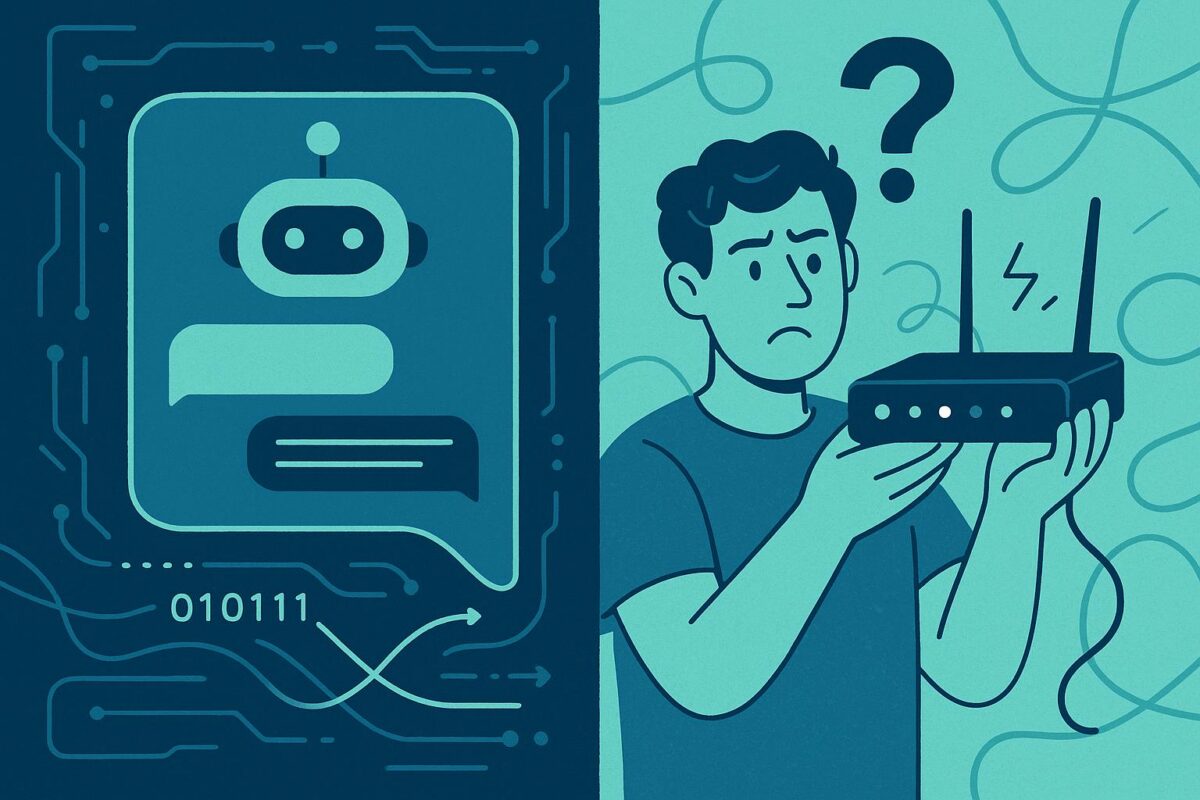
Every AI customer service CSAT story this year follows the same arc: a big number, a confident executive, and a press release that leaves out the most important context. Verizon’s is the latest — and it’s worth slowing down on.
At Bloomberg Tech earlier this month, Verizon CEO Dan Schulman said something that’s going to get repeated in a lot of board decks this summer:
“In the last three months, we have been experimenting with agents that are replacing some of our customer service reps. And those agents, their customer service satisfaction rate is 1,280 basis points better than what we had before.”
1,280 basis points. 12.8 percentage points. That’s a massive number, and Schulman said it with the confidence of someone who has already decided the experiment is over.
Verizon also cut 13,000 employees in late 2025. So the subtext is clear: AI is better, AI is cheaper, the humans are gone.
I’m not here to argue that AI can’t do customer service. It clearly can handle a lot of it. But that 12.8% number is doing a lot of work, and it’s worth asking: which tickets is the AI actually solving?
What “Customer Service” Means at Verizon
Verizon handles millions of customer contacts every month. A huge portion of those are rote: check my bill, change my plan, where’s my order, why was I charged for this, how do I set up autopay. These are text-based, data-retrievable, pattern-matchable questions. Of course an AI agent handles them better than a tired human reading from a script at 2am.
But Verizon also sells physical products — phones, routers, set-top boxes, home internet equipment. And when that equipment doesn’t work, the support ticket looks completely different.
- “My router keeps dropping. I’ve restarted it three times.”
- “My new phone won’t connect to 5G even though I’m in a coverage area.”
- “The cable they ran to my house looks wrong but I don’t know what I’m looking at.”
These aren’t questions you can answer by querying a database. They require seeing what the customer is dealing with. The blinking light pattern on a router. The cable connection that’s half-seated. The phone that shows full bars but still won’t connect. Context that lives in the physical world, not in a ticket system.
AI can’t see any of that. Not yet, not in production, not at Verizon’s scale.
The AI Customer Service CSAT Selection Effect
When Schulman says AI scores 12.8% higher than humans on AI customer service CSAT metrics, he’s almost certainly measuring across the tickets the AI is choosing to handle — the ones it has been deployed on, the ones it’s been trained for, the ones where it has enough data to be confident.
That’s not the same as measuring across all tickets.
The hard tickets — the physical product failures, the complex multi-device setups, the edge cases that require a human to understand what the customer is literally holding in their hands — those are still routing to humans. Or they’re routing to AI and creating frustrated customers who never fill out a CSAT survey because they’ve already switched to T-Mobile.
This is the selection effect problem with every AI customer service announcement: the wins are real, but they’re measured on the easy half of the distribution. The hard half is invisible in the headline number.
The Tickets That Actually Determine If You Keep a Customer
Here’s the counterintuitive truth about customer service: the tickets that determine churn aren’t the easy ones. Nobody leaves a carrier because their billing question got answered in 45 seconds versus 90 seconds. They leave because something broke, they couldn’t figure it out, and they felt like nobody could actually help them.
The high-stakes tickets — device setup failures, equipment malfunctions, installation issues — are also the highest-effort tickets. They’re the ones where a customer is frustrated, confused, and ready to walk. If your AI can’t handle those, you haven’t solved customer service. You’ve automated the parts that didn’t matter as much.
Furthermore, visual context is almost always the missing piece. The customer who calls because their internet is down isn’t describing a database state. They’re describing a physical situation — cables, lights, equipment placement. Getting that resolved over text or voice is like trying to diagnose a car problem over the phone while the car isn’t running and the owner has never looked under a hood. Teams that solve this consistently are cutting unnecessary dispatches with five-minute video triage.
That’s exactly what Viewabo exists to solve. A support agent can start a live video session from any browser, without the customer downloading anything, and see exactly what the customer is seeing. No guessing. No “can you describe the color of the blinking light?” Just: I can see it. Here’s what to do.
What AI Customer Service CSAT Numbers Won’t Tell Your Board
Verizon’s AI story is going to become a template. Leadership at every major company with a customer service operation is going to see those 1,280 basis points and start asking why they still have humans answering phones.
The right answer isn’t “because AI is bad.” The right answer is: figure out which tickets are actually driving your churn, and ask whether AI can handle those specifically.
If your support queue is mostly billing questions and account changes, automate aggressively. However, if your product has a physical component — hardware, installation, anything customers have to set up or troubleshoot in the real world — you have a category of tickets that will break your AI metrics and break your retention simultaneously.
Don’t let a headline AI customer service CSAT number from a carrier’s easy tickets convince you that visual, human context has been automated away. It hasn’t. And the customers who need it most are the ones who are closest to churning.
Viewabo helps support teams see what their customers are seeing — no app download required. Start a free trial.