
Your AI Deflection Numbers Are Up. Your Truck Rolls Probably Are Too.

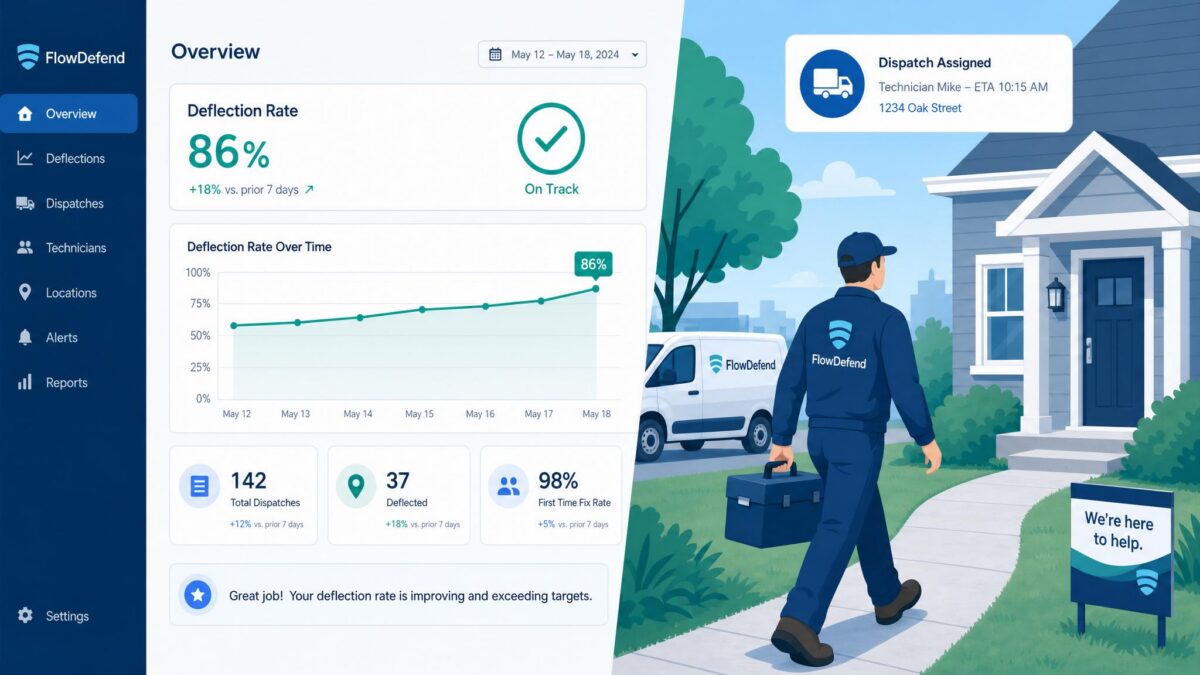
Everyone’s celebrating the same dashboard. Ticket volume down. Deflection rate up. An AI chatbot now handles 40% of contacts without a human touch. The VP of CX is presenting these numbers to the board with a smile. However, for companies in field service, this surge in AI deflection field service metrics often masks a quieter, more expensive problem unfolding in the dispatch queue.
Meanwhile, your dispatch queue is just as long as it was six months ago.
This is the quiet crisis no one’s talking about at AI implementation kickoffs: deflection is not resolution. For companies in field service, physical product support, HVAC, telecom, appliance repair, or any industry where fixing something requires a human body at a location — a deflected ticket that doesn’t solve the problem comes back. It returns as a repeat call, a re-dispatch, a negative review, and ultimately as churn.
The metrics look better. The problem doesn’t.
The Numbers Behind the Numbers
A cross-industry benchmark published earlier this year found that support teams relying on full AI automation clocked a 2.3x repeat-contact rate compared to teams using assisted human resolution. Read that again — not a minor uptick, but more than double the return contacts.
Why? Because AI handles what’s already been documented exceptionally well. It retrieves the right article, walks the customer through the standard flow, and closes the ticket as “resolved.” What it cannot do is recognize that the customer already tried those steps twice, that the unit has a quirk specific to the 2022 production run, or that the wiring diagram they’re following doesn’t match their actual installation.
Customers don’t always know how to describe what they’re seeing. They use approximations: “It’s making a noise.” “The thing isn’t working right.” “I think I did it wrong.” AI systems trained on clean, categorized support data are not built to handle diagnostic ambiguity. Instead, they pattern-match to the closest known issue and close the loop.
Then the technician rolls out anyway.
Forrester Confirmed What Field Teams Already Know
Forrester’s CX Forum West wrapped this week, and the theme was clear: the hard work in AI support starts after deployment, not before. Vendors have spent two years selling the deployment story — implementation timelines, integration specs, deflection projections. Customers who are 12–18 months in are now doing the harder math.
Post-deployment, the metrics that matter shift. Pre-deployment, everyone asks: “What’s the deflection rate?” Post-deployment, the real questions are:
- What percentage of deflected contacts came back?
- Did repeat contacts generate a dispatch?
- What’s the average cost of a re-roll versus a first-visit resolution?
- Is customer satisfaction actually improving, or just ticket count?
For software companies, a repeat contact is annoying. For a field service operation, a repeat contact means a truck, a technician’s time, parts that get ordered and returned, and a customer who’s been without working equipment for an extra 48 hours. The cost asymmetry is enormous. As this gap widens, it starts to undermine the entire ROI case for AI investment. For a deeper look at what gets harder when AI handles the easy calls, the pattern holds across industries.
Why AI Deflection Field Service Metrics Are Structurally Misleading
Here’s the dirty secret of how most AI deflection is measured: a ticket counts as “deflected” when the customer doesn’t escalate within that session. A callback the next day? That becomes a new ticket.
This means your deflection dashboard conflates two very different outcomes:
- Issues that were genuinely resolved
- Issues that were merely paused — the customer gave up for now, or didn’t know they could push harder
Genuine resolutions are a win. Paused issues, however, simply defer the cost. The customer is still frustrated, the problem remains unresolved, and the dispatch is still coming — just on a slight delay.
Companies that don’t connect their CX platform data to their field service management system will never see this pattern. The tickets live in Zendesk; the truck rolls live in ServiceMax or FieldAware. Nobody joins those tables.
The companies that do join them — examining repeat-dispatch rates correlated against first-contact channel — discover a very different picture than their deflection dashboards suggest.
The Problem is Diagnostic, Not Conversational
Most AI support tools are built for conversational resolution. They excel at questions with clear answers: “What’s your return policy?” “How do I reset my password?” “Where’s my order?”
Field service support, in contrast, is diagnostic. The customer stands in front of a piece of equipment that isn’t working as expected, and they need to determine why before anyone can prescribe what to do about it. That diagnostic process — actual triage — requires seeing what the customer is seeing.
Text cannot convey what a grinding noise really sounds like on startup. A written description cannot show you that the condenser coils are iced over due to restricted airflow from a filter the customer hasn’t checked. Words cannot reveal that a non-standard fitting explains everything about why the installation behaves oddly.
Consequently, when the first contact cannot establish ground truth on the physical state of the problem, every subsequent response is essentially a guess. And guesses generate re-rolls.
What Resolution Actually Looks Like in the Physical World
The companies getting this right draw a straight line between the customer’s first contact and the physical reality of their problem. The standard is not “did we close the ticket” — it’s “did the problem stop?”
That’s where Viewabo fits into this. Live visual support — connecting a technician or support rep with the customer’s camera at the moment of contact — collapses the diagnostic gap. Instead of asking the customer to describe what they see, the rep sees it directly. Instead of sending them through three rounds of troubleshooting steps that don’t apply, triage happens in real time.
The deflection that comes from a visual support session is structurally different from the deflection that comes from an AI chatbot. When a rep looks through the customer’s camera and walks them through the fix, the problem is resolved — not deferred, not closed-pending-callback. Resolved. The truck doesn’t roll because it doesn’t need to. Before committing resources to dispatch, a 5-minute video triage at first contact can pay for itself many times over.
That’s what makes deflection actually stick.
What to Audit Before Your Next Board Presentation
If you’re in field service and you’re about to present deflection metrics, do yourself a favor and run these checks first:
Cross-reference ticket and dispatch data. For contacts that were “deflected” in the last 90 days, what percentage resulted in a dispatch within 14 days? If you don’t have this number, that’s your first problem.
Segment by product and issue type. Not all deflection is equal. AI handles account and billing questions cleanly, but physical product diagnostics are another matter entirely. Know which categories are driving your rate.
Look at repeat-contact windows. Most platforms allow you to flag contacts from the same customer within 7, 14, or 30 days. Track this. A customer who calls back within a week almost certainly received no real resolution the first time.
Ask your dispatchers. They know. They can tell you which issues keep coming back, which customers have been out twice, and which ticket categories generate the most re-rolls. The field team holds insight the dashboard never shows.
Calculate the true cost differential. What does a first-visit resolution cost? What does a repeat-dispatch cost when you factor in the prior deflected contact, the follow-up call, and the second roll? In most field service operations, repeat dispatches cost 3–4x more than first-visit resolutions. Therefore, that math changes the ROI conversation on your AI investment significantly.
The AI is not your problem. Incomplete resolution is your problem. In some cases, the AI is making it worse by delivering a number that looks like success while the underlying issue compounds.
Your truck rolls don’t lie. Your dashboard might.
Viewabo helps field service and physical product support teams resolve issues visually at first contact — before a truck ever needs to roll. Learn more at viewabo.com.