
Field Service AI Budgets Are Going Up. First-Time Fix Rates Are Not.

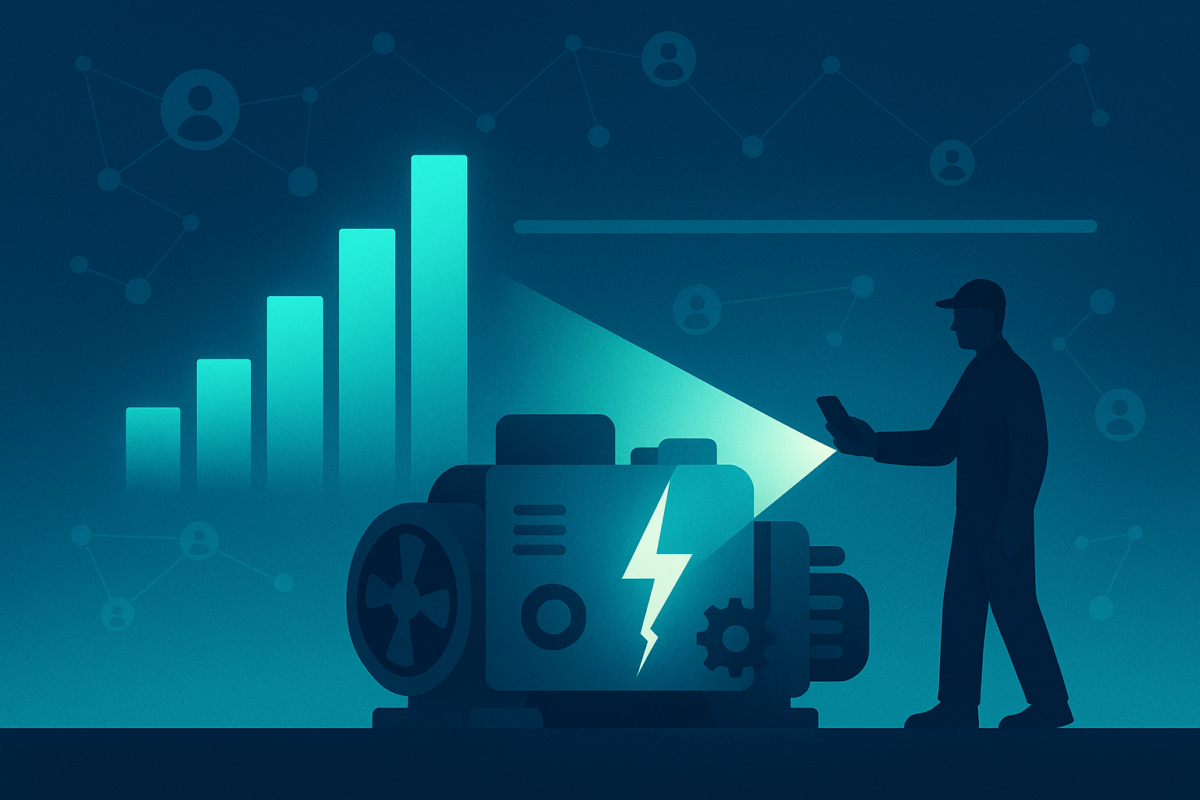
Let me steelman the other side first, because the other side has a point.
AI orchestration is real progress. When HubSpot launched Agent Hub and Agent Builder in public beta this week, it solved a genuine problem: companies had a dozen disconnected AI agents that didn’t share context, and now those agents can work from one unified view of the customer. Fewer silos, more coordination, agents that actually know what other agents did. If your problems live in the CRM, that’s a meaningful upgrade.
Here’s the issue: field service problems don’t live in the CRM.
The budget line goes up. The fix rate doesn’t.
Also this week, an SAP survey landed with a finding that should make every field service leader uncomfortable. Enterprises reported that AI is helping them generate business insights and improve customer interactions — but not save money or time. Read that again. The two things CIOs promised their boards — cost reduction and time savings — are exactly the two things enterprise AI is underdelivering.
Insights and better conversations are lovely. But in field service, the metrics that actually pay the bills are brutally concrete: first-time fix rate, truck rolls per resolution, time-to-resolution. And across the industry, first-time fix rates have been stuck in the same 70-something-percent band for years while AI budgets have doubled and tripled.
That’s not a coincidence. That’s a category error.
You can’t orchestrate your way past a missing input
Every dollar of that rising AI budget is going into the same layer: text and structured data. Agents that read tickets. Agents that summarize CRM history. Agents that route, triage, draft, and follow up. Orchestration platforms — Agent Hub being the newest — that make all those agents share context beautifully.
But here’s what none of those agents can do: look at the broken machine.
The bottleneck in field service was never that your systems didn’t share data. It’s that nobody on the support side can see the physical world where the problem actually exists. The furnace making the noise. The valve that’s installed backwards. The error code on a panel the customer is describing as “some red blinky thing.” No amount of shared CRM context tells you which of the four connectors the customer actually unplugged.
So you get this pattern, over and over: the AI stack does everything right — perfect ticket summary, perfect customer history, perfect routing — and then dispatches a technician with the wrong part, because the diagnosis was built on a customer’s verbal description of something they don’t understand. The truck rolls. The tech arrives. It’s a different problem. Second visit scheduled. Your first-time fix rate just took the hit, and your AI dashboard still shows green because every text-shaped step went flawlessly.
I’ve written before that agentic support can’t see the customer’s problem, and that’s still the core of it. Orchestration multiplies whatever inputs you give it. If the inputs are blind, you’ve just built very well-coordinated blindness.
Why the SAP finding maps perfectly onto field service
Look at where the survey says AI is working: insights and customer interactions. Those are analysis and conversation — the things language models are genuinely great at. Now look at where it’s falling short: cost and time. In field service, cost and time are physical. Cost is trucks, parts, technician hours, repeat visits. Time is how long a machine sits broken.
Language models don’t reduce those numbers by being more articulate. They reduce them by getting the diagnosis right before the truck rolls — and diagnosis requires seeing the thing. When your only sensor into the customer’s environment is the customer’s vocabulary, you’ve capped your diagnostic accuracy at whatever a stressed non-expert can describe over the phone. Every time you route a field problem through a text-only stack, you’re paying twice: once for the AI, and again for the truck it failed to prevent.
The missing input is visual, and it’s embarrassingly cheap
Here’s the part that should annoy every CFO reviewing an AI budget: the input that actually moves first-time fix rate costs a fraction of the orchestration layer sitting on top of it.
Remote video support — the customer taps a link, their phone camera becomes the support agent’s eyes, no app install — changes the diagnostic equation completely:
- First-time fix rate goes up because the technician (or the agent, or the AI triage layer) sees the actual fault before anyone decides what part to bring.
- Truck rolls go down because a meaningful share of “field” problems turn out to be resolvable in five minutes of guided video — a loose cable, a wrong setting, a reset sequence the customer couldn’t follow from text.
- Time-to-resolution collapses because you skip the entire failure loop of describe → guess → dispatch → discover → redispatch.
And critically: visual context makes every downstream AI investment better. A vision-capable triage flow with a live camera feed has ground truth. An Agent Hub full of agents sharing a video-confirmed diagnosis is orchestrating something real instead of orchestrating a guess.
Spend the next dollar on eyes, not another agent
I’m not telling you to cancel your AI roadmap. Orchestration matters, and platforms like Agent Hub will genuinely help go-to-market teams. But if you run field service and your board is asking why the AI budget tripled while first-time fix rate moved one point, the answer isn’t a better orchestration layer. It’s that you keep buying more processing for the same blind inputs.
The SAP survey is telling you where the ceiling is. AI is great at insights and conversation because those run on data you already have. It’s failing at cost and time because those depend on data you don’t have — what’s physically happening at the customer’s site.
Add the camera. Get the visual context into the front of the funnel. Then let all those expensive, beautifully orchestrated agents work on a diagnosis that’s actually correct. Your fix rate will move — and for the first time, your AI spend will show up in the two columns the board actually reads.