
The Support Interaction That No AI Workflow Platform Will Ever Automate

Last week was a big one for AI support platforms. On July 22, OpenAI launched Presence, an enterprise platform for deploying AI agents across customer support and internal workflows. The same day, ServiceNow reported that its AI annual contract value crossed $1 billion, up more than 40% sequentially, prompting Goldman Sachs to declare the company is “writing a totally new playbook.”
Two of the most powerful companies in software, on the same day, telling the same story: AI agents are eating enterprise support. The money is real. The deployments are real.
And yet there is one support interaction that neither of them — nor any AI workflow platform, ever — will automate. It’s worth being precise about which one, because that’s where the next decade of support economics actually gets decided.
What Presence actually is (and isn’t)
Read the fine print on Presence. It’s not self-service. Deployments are led by OpenAI’s own Forward Deployed Engineers and select global systems integrators, available only through a limited general availability program for eligible enterprises. When a use case goes beyond what the product supports, OpenAI sends humans to build it.
I wrote about this trend months ago — the forward-deployed engineer is coming to enterprise support — and Presence is the loudest confirmation yet. Even the company selling autonomous agents admits that making them work requires people on the ground, embedded in your systems, looking at your actual environment. Hold that thought, because it’s the whole argument in miniature.
What does Presence automate? Agents that answer questions, access company systems, take approved actions, and escalate to humans — across voice and chat. ServiceNow’s billion dollars of AI ACV covers the same territory: tickets, workflows, routing, records, resolution flows. Every one of these is an interaction where the problem arrives as text or structured data.
The interaction that resists
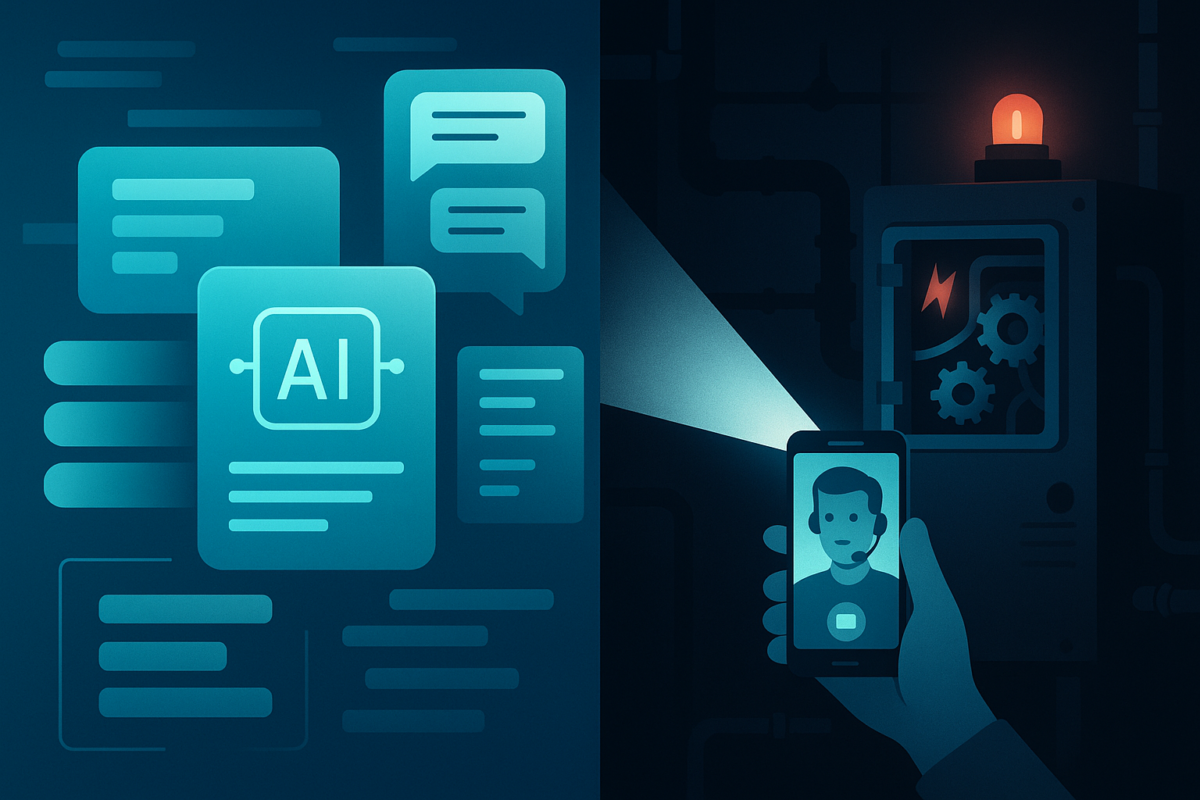
Here is the support interaction no AI workflow platform will ever automate: the one where someone has to see a physical thing that’s broken.
A commercial HVAC unit throwing a fault code that doesn’t match the manual. A medical device with a cable routed wrong. A router install where the customer swears the light is green but the connection is dead. A $40,000 piece of lab equipment making a noise nobody can describe in words.
These problems don’t arrive as text. They arrive as a confused human standing in front of a machine, trying to translate a three-dimensional physical situation into a chat box. And the translation is where everything falls apart. The customer doesn’t know which part is the compressor. They don’t know the difference between “blinking amber” and “solid amber.” They describe the symptom they perceive, not the state that exists. Any agent — human or AI — working from that description is reasoning from corrupted input.
This isn’t a model-capability problem. GPT-6 won’t fix it. The models can already reason about images and video better than most tier-1 agents. The problem is the input pipeline: the physical world doesn’t have an API. Presence can connect to your CRM, your knowledge base, your order management system. It cannot connect to the underside of a customer’s dishwasher.
I’ve made this argument before: agentic support is here, but seeing the customer’s problem isn’t. Nothing in last week’s announcements changes that. If anything, they sharpen it.
Why the biggest AI deals ignore this — for now
It’s not that OpenAI and ServiceNow don’t know physical support exists. It’s that their platforms are built around the inputs they can ingest. Text tickets, voice transcripts, system logs, database records — these are legible to a workflow engine. So the nine-figure deals get written around the legible work, and the physical layer gets quietly scoped out of the contract.
The result is a predictable distortion. As AI absorbs the text-shaped work — password resets, order status, policy questions — the queue that remains gets denser with the problems that were never text-shaped to begin with. The hard residue of support is disproportionately physical: installations, hardware faults, damage claims, anything where the truth lives in the room with the customer rather than in your systems. Pay-per-resolution pricing only makes sense if your problems are text-shaped, and an ever-growing share of what’s left won’t be.
So the companies celebrating their deflection numbers are, in effect, concentrating their most expensive failure mode. Every physical problem forced through a text pipeline gets handled the old way: long back-and-forth, guessed diagnoses, a parts shipment that’s wrong half the time, and eventually a truck roll that costs $200–$1,000 to confirm something a camera could have confirmed in ninety seconds.
The missing input is visual
The fix isn’t a smarter agent. It’s a better input. The moment a support interaction involves a physical object, the highest-leverage move is to stop transcribing and start looking — get the customer’s smartphone camera pointed at the problem, live, with an expert (or increasingly, an AI) on the other end seeing exactly what exists rather than what the customer managed to describe.
That’s the layer we build at Viewabo: remote visual support through the customer’s phone camera, launched from a link, no app download. Not because AI workflow platforms are wrong — they’re clearly winning the text layer, and they should — but because the visual layer is the input those platforms are missing. Ground truth from the physical world is what turns “the customer says it’s broken” into “here is what is actually broken.” Feed that into your workflow engine and the automation gets dramatically better. Skip it and you’re automating on top of hearsay.
The playbook nobody’s written yet
Goldman says ServiceNow is writing a totally new playbook. Fine. But the new playbook, like the old one, still assumes the problem walks in the door as data. OpenAI’s own launch tells you what happens when reality is messier than the data model: you send humans to go look at the thing.
That instinct — when it matters, go see it — is exactly right. The companies that win the next phase of support won’t be the ones that automate the most interactions. They’ll be the ones that recognize which interactions need eyes, and build the fastest path to seeing. Everything else is a chatbot arguing with a description of a machine it will never look at.