
GE Appliances Visual Support: Put the Refrigerator in Its Installation Context

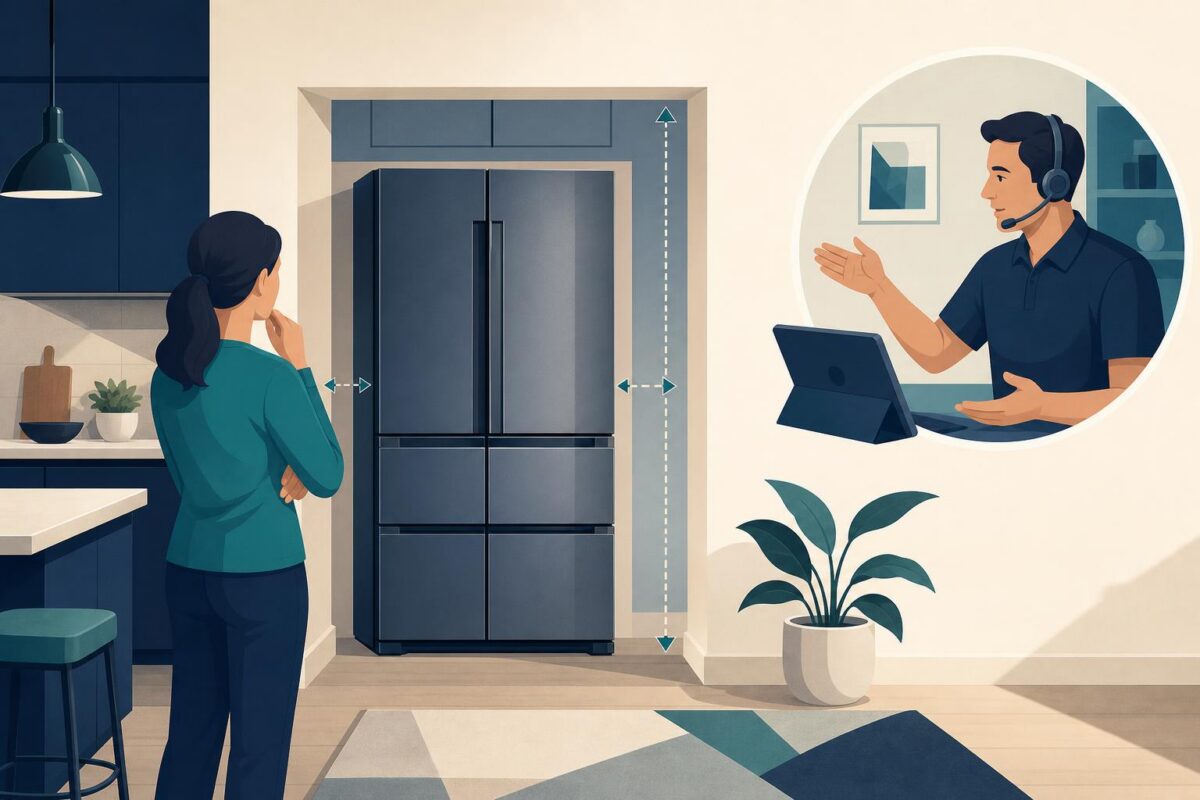
GE Appliances visual support could improve the preparation for a refrigerator service decision. A customer reports a concern with cooling, a door, or another ordinary function. The technician needs the exact appliance and its installation context, but a short ticket may reduce the whole situation to refrigerator problem.
Viewabo is a strong prospective fit when physical context would make that first service decision more precise. This article is an independent analysis, not a claim that GE Appliances uses or endorses Viewabo.
Identify the configuration before interpreting the complaint
GE Appliances’ KBIS 2020 refrigeration announcement describes several refrigerator configurations across its portfolio. That variety supports a practical intake rule: support should establish the actual appliance and affected area instead of assuming every refrigerator has the same arrangement.
For a hypothetical complaint, a customer may refer to a door or compartment without using the term in the relevant manual. A shared reference can clarify which area they mean. The agent should preserve the original observation before translating it into a service category.
Also ask when the concern started and what changed around that time. A recent delivery or kitchen change is context worth recording, not proof of an installation fault. The investigation should distinguish history from established cause.
GE Appliances visual support could prepare the site brief
A safe external view may help the customer show the accessible appliance arrangement and surrounding space. That context can make a door-clearance or access question easier to explain to the receiving specialist.
Do not ask the customer to pull out a heavy refrigerator or expose service areas merely to improve the view. If a relevant fact is not safely accessible, identify it as a question for the technician. A useful intake process respects what remote observation cannot establish.
The same principle applies to measurements. A picture can identify the area under discussion, but required dimensions or technical findings must come from the appropriate process. Avoid certifying an installation from an impression of how it looks.
Keep operating observations separate from cooling conclusions
A display reading, a customer’s impression, and an actual measurement can answer different questions. Support should label them accurately. A visible control setting does not by itself establish the temperature throughout the appliance or explain the reported concern.
The refrigerator support workflow separates reported temperature concerns from unverified assumptions about the appliance.
Use the correct product guidance to decide which ordinary observations are relevant. The agent should not infer food safety, equipment condition, or the need for a particular repair from appearance alone. Time-sensitive concerns need the appropriate guidance and service response.
Viewabo could help the customer and support team discuss the physical arrangement while those other questions follow their proper paths. It does not replace refrigeration diagnostics or a qualified technician’s assessment.
Make dispatch depend on a defined unresolved question
A service visit should have a clear purpose. The technician may need to investigate a reported operating concern, assess an installation condition, or verify a specific unresolved observation. State that question in the handoff rather than invent a component failure.
Include the relevant model identity, affected area, reported timeline, and completed approved checks. Explain which information was directly observed during support and which came from the customer’s account of an earlier event.
This helps the technician prepare without promising that remote intake has settled the cause. It can also help the customer understand why a visit is appropriate and what remains to be established onsite.
Preserve access and authorization details through the normal process
The person calling may not be the person who will meet the technician. Use the service organization’s approved process to confirm access arrangements and responsibility. A well-described symptom is still an incomplete visit brief if no authorized person can receive the service.
Likewise, distinguish assessment from approval for additional work. The customer should know which decision will happen during the visit and which commercial choices remain theirs. Better visual context does not authorize an unagreed repair.
After the visit, return to the original reported outcome. A completed service task may need follow-up over an appropriate observation period. Keep the result and any remaining uncertainty visible in the case rather than treating technician departure as automatic resolution.
Evaluate GE Appliances visual support through dispatch quality
A pilot could focus on refrigerator cases with unclear physical descriptions. Review whether technicians receive the correct appliance identity and site context, whether they repeat intake questions, and whether the visit addresses the customer’s original concern.
The wider case for video in customer support applies before a specialist travels. GE Appliances could evaluate Viewabo where seeing the refrigerator in its real setting improves the service brief without pretending that an image can replace technical diagnosis.