
Microsoft Saved $500 Million on AI Support. Nobody Saved Anything on Truck Rolls.

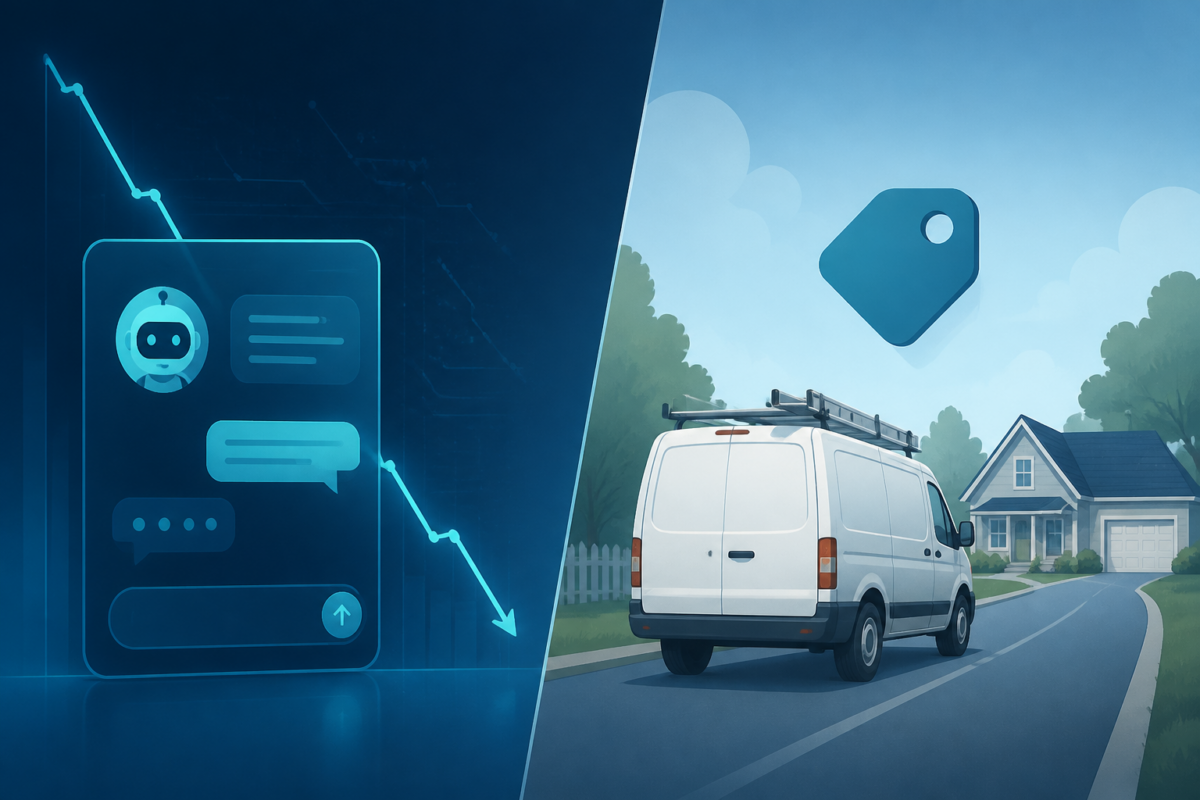
This week, Bloomberg and the LA Times confirmed what everyone in support has been whispering about for two years: AI’s decimation of call center jobs has officially begun. Microsoft attributed $500 million in savings to automated support. Uber cut 10% of its Community Operations team. Commonwealth Bank of Australia eliminated 120 customer service roles outright. Hyatt is routing guest requests through automated systems.
Half a billion dollars at one company. Real layoffs, real numbers, real quotes from real executives.
Now here’s the detail that didn’t make a single headline: none of these companies announced cuts to field technicians. Not one dollar of Microsoft’s $500 million came from a truck that didn’t roll.
The $500 million came from exactly one place
Look at what actually got automated. Password resets. Billing disputes. Account questions. Ride refunds. Loan status inquiries. Every single job AI eliminated at Microsoft, Uber, and CBA had one thing in common: the problem arrived as text. A customer typed a sentence, the answer lived in a database, and a language model connected the two faster and cheaper than a human ever could.
That’s the text layer of support, and yes — AI is annihilating it. It should. Most of that work was humans acting as slow, expensive APIs between a customer and a knowledge base. I’ve written before about why pay-per-resolution pricing only works when your problems are text-shaped, and this week’s news is the same principle playing out at planetary scale.
But support has two layers, and only one of them just got cheap.
The physical layer hasn’t saved a dime
The other layer is the expensive one: the router that won’t sync, the HVAC unit throwing an error code, the medical device that’s beeping in a way the manual doesn’t describe, the installation that “looks wrong” in a way the customer can’t articulate. These problems don’t arrive as text. They arrive as things in the physical world that someone has to see.
And the way most companies handle “someone has to see it” hasn’t changed since the 1980s: put a human in a truck and drive them to the problem.
Industry data puts a single truck roll anywhere from $150–$300 on the low end to over $1,000 once you count labor, fuel, vehicle overhead, and the jobs that tech didn’t do while sitting in traffic. Worse, roughly 25% of truck rolls are non-value-add or outright avoidable — the tech shows up, flips a switch or reseats a cable, and drives home. That’s a $1,000 visit to do ninety seconds of work that the customer could have done themselves if anyone could have seen what they were looking at.
Run the math on your own dispatch volume. If you roll 10,000 trucks a year at even $400 each, and a quarter of them are avoidable, that’s a million dollars a year spent driving to problems that never needed a drive. Microsoft’s $500 million is a headline. Your avoidable dispatch spend is a line item nobody’s touched.
Why AI skipped the expensive part
It’s not because the physical layer is smaller. Field service is a multi-hundred-billion-dollar cost center globally. It’s because the bottleneck there isn’t conversation — it’s visibility.
A chatbot can’t tell you whether the cable is in the right port. An LLM can’t read the blink pattern on a status light. The world’s best language model, fed a customer’s description of “it’s making a weird noise,” has exactly as much information as a 1996 call center agent did — because the customer’s description is the input, and customers are terrible sensors. That’s why AI deflection numbers go up while truck rolls do too: the bot deflects the text-shaped tickets and dutifully escalates every physical one straight to dispatch, because dispatch is the only tool it has for problems it can’t see.
So the industry automated the layer where the marginal cost of a resolution was already a few dollars, and left untouched the layer where every escalation costs hundreds. We optimized the cheap part. It’s exactly backwards, and it happened for a simple reason: text was easy and seeing was hard.
Seeing is no longer hard
Here’s the part that should bother every COO reading the Bloomberg piece: the technology to close the visibility gap already exists, and it’s radically simpler than the AI stack that saved Microsoft $500 million. Every customer is holding a high-resolution camera. The only thing missing is a frictionless way to point it at the problem while someone qualified — human or, increasingly, AI — watches.
That’s the entire premise behind Viewabo: an agent sends a link, the customer taps it, and their smartphone camera becomes the technician’s eyes. No app download, no account, no “please hold while I schedule someone for Thursday between 8 and 5.” Two minutes of live video routinely answers the question a truck roll exists to answer: what is actually going on out there? Sometimes the answer is “reseat the cable, you’re done” — an avoided dispatch. Sometimes the answer is “it’s the compressor, send a tech with the right part” — a dispatch that resolves on the first visit instead of the second. Both outcomes are worth hundreds of dollars, per incident, every time.
The first decision in any physical support escalation should never be “send a tech”. It should be “look first.” Every truck that rolls without anyone looking first is a bet — at $400 to $1,000 a ticket — that the customer’s verbal description was accurate. A quarter of the time, you lose that bet.
The next $500 million
The text layer of support is a solved problem. This week’s layoffs are just the accounting catching up. The companies that ran that playbook are done harvesting those savings — Microsoft can’t save the same $500 million twice.
The next wave of support savings doesn’t live in the contact center. It lives in the parking lot, in the fleet of trucks rolling toward problems nobody looked at first. The physical layer of support is the last enormous, undisrupted cost pool in the industry — and unlike the text layer, disrupting it doesn’t require a frontier model. It requires a camera, a link, and the organizational discipline to make “see it before you send someone” the default.
AI ate the conversation. The visibility layer is still on the table. The companies that figure that out will write the next round of headlines — and this time the savings will be measured in trucks that never left the lot.