
Why I Waited Too Long to Add Self-Service to My B2B SaaS

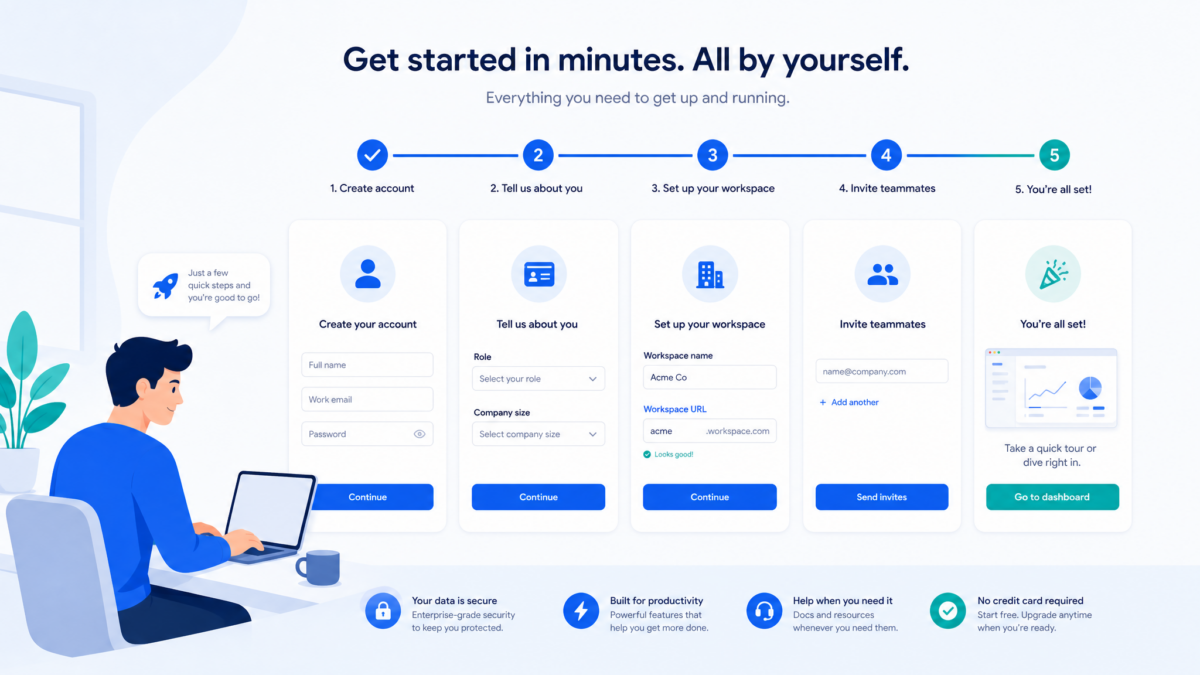
There’s a version of this post I could write that makes me look smart. In that version, I carefully analyzed the market, weighed the tradeoffs, and made a deliberate strategic decision to add self-service B2B SaaS functionality at exactly the right moment.
That’s not what happened.
What actually happened is that I avoided the decision for a long time, with increasingly elaborate justifications, until the gap between what our product was and what it could be became impossible to ignore.
Here’s what I kept telling myself, and why I was wrong.
“B2B is different. Our buyers need a demo.”
This was my main defense for two years. And it’s not entirely wrong — enterprise software with six-figure contracts and complex integrations genuinely does need a sales motion. But I was using enterprise logic to justify a sales-led approach for a product that costs under $200 a month.
The tell was what happened on discovery calls. Nine out of ten times, someone would ask me a question that could have been answered by just trying the product. “Can it do X?” Yes. “What does it look like when Y happens?” Let me show you. We were doing live demos of things users could have discovered themselves in ten minutes.
The demo wasn’t adding value. It was filling a gap that shouldn’t have existed.
“Our users aren’t technical. They need handholding.”
This one felt caring. In practice, it was patronizing.
Here’s the thing about self-service: it doesn’t mean throwing users into the deep end and hoping for the best. It means building an experience where someone can figure out the core value of your product without talking to you first. That’s a product design challenge, not a reason to block signups.
The assumption that your users are incapable of self-discovery is usually not true, and even when it is, the solution is better onboarding, not gatekeeping. Friction doesn’t filter for quality buyers. It just filters for persistence, which correlates weakly with actual fit.
“We’ll get low-quality signups that waste our time.”
This one has some truth in it. You will get people who are clearly not your ICP. You will get tire-kickers, students, and competitors doing recon. These are real costs.
But here’s what I underweighted: the cost of not getting found.
Every month we operated without self-service B2B SaaS access was a month where someone searched for what we do, landed on our site, saw a “Contact Us” button, and left. Not because they weren’t interested, because friction. The low-quality signups are a cost you can see. The qualified buyers you never heard from are invisible.
When you add it up, the invisible cost is almost always larger.
“We need to control the narrative early.”
Translation: I was worried people would try the product before it was perfect and judge it harshly.
There’s a founder instinct to protect the product — to want every evaluation to happen with a guide present, where you can explain context, pre-empt confusion, and frame the experience correctly. It feels responsible. It’s actually just fear.
Products that need a guide to be understood have a different problem. Adding self-service doesn’t create that problem; it reveals it. And the sooner you can see where users get stuck without you there to rescue them, the sooner you can fix it.
What finally changed
Honestly? A few things converged.
The first was watching how people found us. Most of our leads came inbound, someone read something, searched for a solution, found us. They weren’t waiting to be sold to. They were actively looking. Making them request a demo was like posting a “check back later” sign on a store that was technically open.
The second was the mental model shift about what a free trial actually is. I used to think of it as giving something away. It’s not. It’s letting people evaluate whether what you built is worth paying for. If you believe in your product, you should want that evaluation to happen as easily as possible.
The third was accepting that a sales motion and self-service aren’t mutually exclusive. Enterprise accounts still get demos. Larger companies still go through a formal evaluation. But smaller companies, individuals, and anyone who wants to explore independently now can. You don’t have to choose.
When we finally launched self-service signups for Viewabo, it confirmed what I’d been avoiding admitting: we should have done it sooner.
The actual tradeoffs of self-service B2B SaaS
I don’t want to make this sound like self-service is obviously correct for every B2B SaaS. There are real costs.
You need to invest in onboarding. Not a wizard with six steps and confetti — actual documentation, empty state messaging, and a clear path to the first moment of value. If you skip this, churn in the first week will be brutal.
You need to be honest about your activation event. What does someone need to do to actually understand why your product exists? For Viewabo, it’s completing a video session. Until that happens, the user hasn’t seen the product. Every piece of onboarding needs to point toward that moment.
You need email sequences that trigger based on behavior, not just time. Drip campaigns that send “Day 3 tip” emails regardless of what someone has done are noise. If someone completed a session on day 1, don’t send them a “getting started” email on day 4.
These are solvable problems. They’re not reasons to avoid the decision.
The question worth asking
If a qualified buyer landed on your site right now and wanted to try your product without talking to anyone, could they?
If the answer is no, ask yourself honestly why. Not the version you’d say in a board meeting. The real reason.
In my case, the real reason was that I hadn’t prioritized it, and prioritizing it meant accepting that I couldn’t control every first impression. That felt risky. It turned out the actual risk was the opposite, staying invisible to everyone who wasn’t willing to book a call.
We shipped self-service this month. Too late, probably. But the good news about a decision you’ve been avoiding is that you can still make it.
George Cheng is the founder of Viewabo, which lets you see what your users see without screen share, plugins, or a call. It now has a free trial.