
How Smart HVAC Teams Diagnose Problems Before Sending a Truck

The truck is already rolling when the callback comes in.
“The unit’s still blowing hot. Technician said it was the capacitor, replaced it, and left. But it never got cold.”
This scene plays out hundreds of times a day at HVAC companies across the country. A technician drives 45 minutes to a call, misdiagnoses the problem, orders the wrong part, and has to come back, sometimes twice. The customer is frustrated. The company absorbs the labor cost. And the $12 capacitor fix turns into a $300 callback nightmare.
The problem isn’t technician skill. It’s information. The tech arrived at the call knowing almost nothing about what they’d find.
The fix is surprisingly simple: use video diagnosis before dispatch to see the problem before you drive to it.
What Happens When You Use Video Diagnosis Before Dispatch
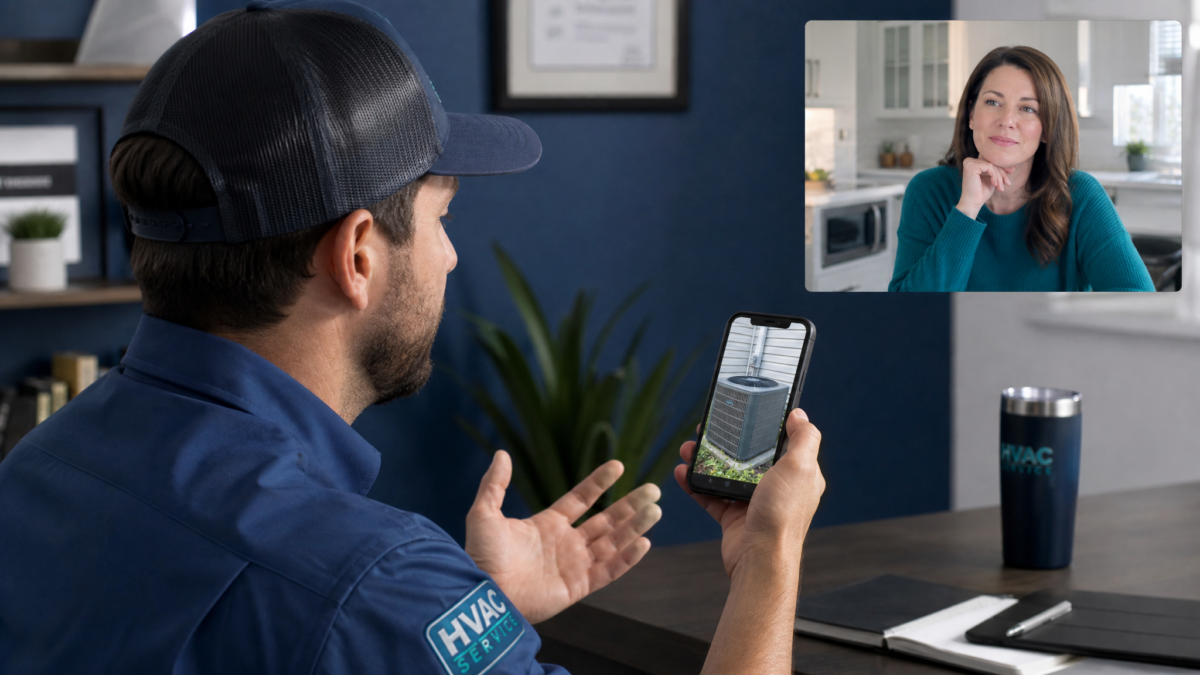
More HVAC companies are adding a short video call step before dispatch, not to replace the site visit, but to triage it.
Before a truck rolls, a dispatcher or senior tech gets on a quick video call with the homeowner or building manager. They ask them to walk around the unit, show the thermostat settings, describe what happened before it stopped working. On a live video call, you can spot:
- Ice buildup on the refrigerant lines (refrigerant leak or airflow problem, not a capacitor)
- A tripped breaker that wasn’t reset (five-minute fix, no truck needed)
- A clearly failed compressor that needs parts ordered before the visit
- Dirty filters or blocked vents (homeowner can fix on their own)
In five minutes of video diagnosis before dispatch, a dispatcher can determine whether to send a truck, what parts to load, and how long the job will realistically take.
That’s not just a better customer experience, it changes the math on every call.
The Numbers Behind Video Diagnosis Before Dispatch
Industry data on HVAC field service is pretty consistent on a few points:
- The average HVAC truck roll costs $75–$150 in labor and fuel before the technician even opens a toolbox.
- First-time fix rates average 65–75% across field service industries. That means 25–35% of calls require a second visit.
- A single unnecessary callback, wrong part, wrong diagnosis, problem reoccurred, often costs more in rescheduling and customer retention than the original call was worth.
If your team runs 20 calls a day and 6 of those result in callbacks, you’re burning a truck roll on 6 extra visits. At $100 average cost per roll, that’s $600/day, $15,000/month in avoidable cost.
A pre-dispatch video call that eliminates even 2 of those 6 callbacks pays for itself in the first week.
Why Photos and Phone Calls Aren’t Enough
The obvious question: “Can’t we just ask the customer to send photos?”
Photos work for visible damage, a clearly cracked heat exchanger, obvious flood damage, a unit that’s been hit by a lawnmower. But most HVAC problems aren’t photogenic. A system with a refrigerant leak looks perfectly fine from the outside. Ice on the lines might have thawed by the time the photo is taken. A failing capacitor doesn’t announce itself visually.
A phone call is worse. Describing HVAC problems in words is notoriously unreliable. “It’s making a rattling noise” could be a loose panel (free fix) or a failing inducer motor (major repair). Without seeing it, you’re guessing.
Live video gives the technician a real-time look with the ability to direct the customer: “Can you get the camera closer to that connection there? Can you hear it from that side?”
That interactivity is what a photo can’t replace. For a deeper look at why static images fall short in technical support situations, see our post on why photos fail in customer support and what video does differently.
What the Best Teams Are Doing
The HVAC companies getting the most out of video diagnosis before dispatch tend to share a few practices:
1. Make the video call part of the booking confirmation.
Rather than scheduling a call as a separate step, they include it in the initial appointment confirmation: “We’ll do a quick 5-minute video call an hour before your appointment to make sure we bring the right parts.” Customers see this as a service upgrade, not a hurdle.
2. Keep it short and structured.
The goal is triage, not troubleshooting. A dispatcher with a checklist, age of unit, symptoms, last service date, visual of the equipment, can capture everything useful in under 10 minutes.
3. Use the video to set expectations.
If the video diagnosis reveals a likely compressor replacement, the customer can be told on the call that they’re looking at $1,200–$1,800, not a $150 service call. This reduces sticker shock on arrival and eliminates the “I need to think about it” call-back that ties up a tech’s afternoon.
4. Capture it for callbacks.
If the call is recorded and the same customer calls back a month later with the same problem, the history is there. No starting from scratch.
The Tool Question
You don’t need anything elaborate. The requirements for video diagnosis before dispatch are minimal:
- The homeowner should not need to download an app (friction kills participation rates)
- The video should work on any smartphone
- The dispatcher should be able to annotate or point at things on-screen
- It should just work the first time, every time
Most FaceTime and Zoom calls fail this last test when customers aren’t tech-savvy. They accidentally flip the camera, can’t figure out how to switch from front to back, or drop off when they accidentally tap the screen.
The best tools for this use case send the customer a simple link, they tap it, camera opens, call starts. No app, no account, no instructions needed.
That’s what your dispatchers actually need: something a 70-year-old homeowner in Phoenix can use without a tutorial.
Is Video Diagnosis Before Dispatch Right for Your Team?
It works best when:
- Your average drive time to a call is 30+ minutes
- You frequently encounter “wrong parts” situations or callbacks
- You have a dispatcher or senior tech who can triage calls
- Your customers tend to be homeowners or small business owners (not complex industrial)
It’s less useful if your calls are all within 5 miles, or if you’re doing primarily planned maintenance where the tech already knows exactly what they’ll find.
For most residential and light commercial HVAC teams, the math on pre-dispatch video is clear. A five-minute call that eliminates one unnecessary truck roll per day pays for any tool you’d use to run it, many times over.
The Case for Video Diagnosis Before Dispatch
Sending a truck before you’ve seen the problem is an expensive habit. The good news is it’s also a fixable one.
A quick video call before dispatch doesn’t slow down your operations, it makes them faster. Your techs arrive with the right parts, your customers get a first-time fix, and your dispatchers stop getting angry callbacks from technicians standing in front of equipment they didn’t expect.
See the problem first. Then send the truck.
Viewabo lets HVAC dispatchers start a live video call with any customer, no app download required. The customer gets a link, taps it, and you can see exactly what they’re dealing with. Start a free trial →