
The Resolution Economy: Why Call Deflection Is the Worst Metric in Customer Support

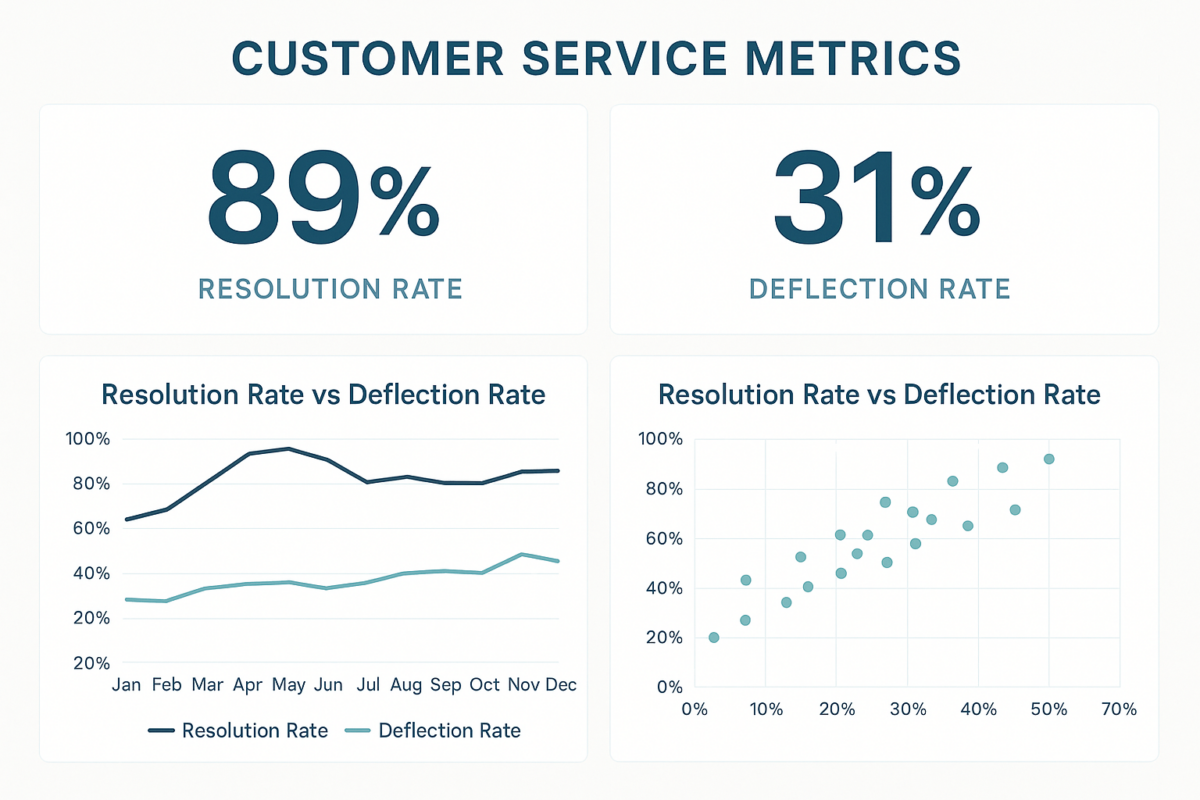
There’s a metric that every support team tracks, every vendor sells against, and every executive celebrates. This is especially relevant when thinking about call deflection.
Call deflection rate.
The idea is simple: if a customer doesn’t call you, that’s a win. Every chat resolved by a bot, every ticket closed by a knowledge base article, every human interaction avoided, that’s money saved. Efficiency gained. Progress made.
Except it’s not.
At Enterprise Connect 2026, the biggest customer experience conference in the world, something unusual happened. The companies that built call deflection technology started admitting it was the wrong goal.
Amazon Said It Out Loud: Understanding call deflection
Amazon Connect, the cloud contact center platform used by thousands of companies worldwide, made a statement that should have been a headline:
“Deflection is the wrong goal. Relationships are the goal.”
Read that again. The company that arguably pioneered scalable customer self-service just told an audience of CX professionals that avoiding customer contact isn’t the point.
They’re not alone.
Zoom Coined a New Term
Zoom’s CX team introduced the concept of a “resolution economy”, a framework where success is measured by outcomes resolved, not calls avoided. In their view, the question isn’t “how many customers didn’t need to call us?” but “how many customers got their problem actually fixed?”
That distinction sounds subtle. It’s not.
A deflection-first strategy optimizes for the company. A resolution-first strategy optimizes for the customer. And in 2026, customers can tell the difference.
The Data Backs This Up
Here’s what happens when you optimize for deflection:
- 41% of consumers say AI has made customer service worse, not better (Gartner, 2026)
- 73% of customers still prefer human support for complex issues, not because humans are faster, but because they actually solve things
- 3 in 10 companies will damage their customer experience this year by deploying AI that deflects rather than resolves (Gartner prediction)
The pattern is clear: companies deploy chatbots to deflect volume. Customers hit the chatbot wall. Simple issues get resolved. Complex issues get bounced. Frustrated customers churn, leave bad reviews, or both.
Deflection “worked”, the call didn’t happen. But neither did the resolution.
The Agent Experience Crisis Nobody Talks About
Here’s the hidden cost of deflection-first AI: it makes human agents’ jobs harder, not easier.
When AI handles the easy stuff, password resets, order tracking, FAQ lookups, the only cases that reach human agents are the hard ones. The emotional ones. The customers who’ve already been bounced by a bot three times and are furious.
Enterprise Connect 2026 speakers described this as the “agent experience crisis.” AI was supposed to make agents’ lives better. Instead, every human interaction became more complex, more emotional, and more draining.
AI didn’t replace agents. It concentrated the worst calls onto them.
The resolution economy flips this on its head. Instead of asking “how do we avoid this call?”, it asks “how do we make this call fast, accurate, and satisfying?” Instead of deflecting complexity, it gives agents tools to handle it.
What Resolution Actually Looks Like
Here’s the thing about complex customer problems, most of them are visual.
A customer’s device isn’t working. Their installation is wrong. Something is physically broken, misconnected, or installed upside down. No amount of chat scripting or knowledge base articles will solve a problem the agent can’t see.
The resolution economy demands a different kind of tool:
- The customer shows the problem, no downloads, no apps, just a camera link
- The agent sees the problem, live, in real-time, with full visual context
- The problem gets solved, first contact, single session, done
This isn’t theoretical. Field service companies that switched from verbal troubleshooting to visual support report 30-40% reductions in truck rolls, 25% faster resolution times, and dramatically higher CSAT scores.
The math is simple: when you can see the problem, you can fix the problem.
The Companies That Get It
The smartest CX teams in 2026 aren’t measuring how many calls they avoided. They’re measuring:
- First Contact Resolution (FCR), was the problem solved the first time?
- Customer Effort Score (CES), how hard did the customer have to work?
- Time to Resolution, not “time to deflection” but actual resolution
- Outcome Rate, of the customers who engaged, what percentage got their problem fixed?
These metrics align incentives correctly. They reward solving problems, not avoiding them.
Salesforce’s new Agentforce Contact Center prices at $2 per resolved conversation, not per deflected one. Even the pricing models are shifting toward outcomes.
The Deflection Trap
If your support strategy is built around deflection, here’s what’s probably happening right now:
- Your chatbot handles 60% of inbound volume (looks great on the dashboard)
- The remaining 40% is increasingly complex, angry, and expensive
- Your agents are burning out because every call is now a hard call
- Your CSAT is flat or declining despite “improved” automation metrics
- Your churn is creeping up but nobody’s connecting it to the CX data
This is the deflection trap. The numbers look good until they don’t.
The Shift Is Already Happening
Enterprise Connect 2026 wasn’t aspirational. It was descriptive. The biggest platforms in CX, Amazon, Salesforce, Zoom, RingCentral, NICE, are all moving toward resolution-first models.
For support teams, the implication is clear: stop celebrating avoided calls. Start celebrating solved problems.
And for the problems AI can’t solve, the ones that require actually seeing what’s wrong, give your agents the tools to see them.
The resolution economy is here. The only question is whether your support team is measuring the right thing.
Visual support lets customers show you the problem instead of describing it. No apps, no downloads, just a camera link that works. Learn how it works →
Post Notes (internal, not published)
Word count: ~920 words
Readability: Short sentences, active voice, subheadings every 200-250 words → should hit green Yoast readability
SEO notes: “Call deflection” has moderate search volume in CX/support circles. Secondary keywords: resolution economy, first contact resolution, customer effort score. Internal links: can link to the “AI Customer Support Is Making Things Worse” post once published.
Sources:
– Amazon Connect quote: Enterprise Connect 2026 keynote (March 11, 2026)
– Zoom “resolution economy”: Enterprise Connect 2026 sessions
– Gartner 41% stat: Gartner Customer Experience Survey 2026
– Salesforce Agentforce pricing: Salesforce Agentforce announcement (March 2026)
– G2 AI in Customer Support Report (February 2026)
For additional context, see recent analysis from Harvard Business Review on trends in this space.