
Every Time You Route a Field Problem Through a Chatbot, You’re Paying Twice

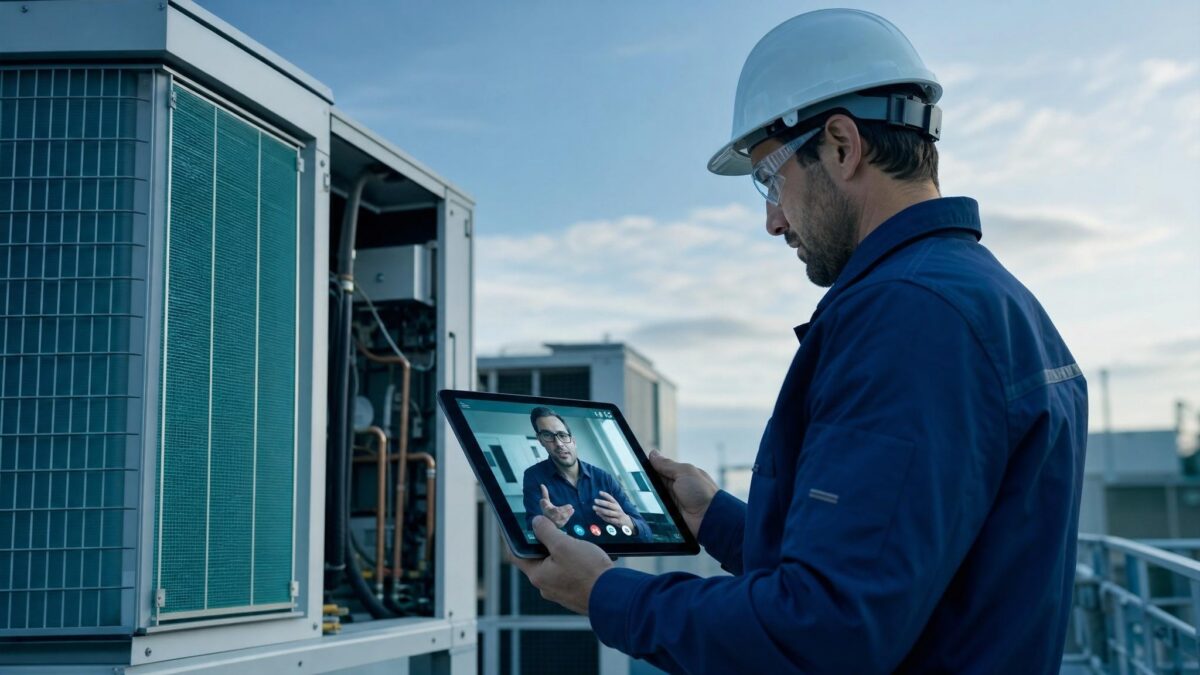
Every time a field problem hits your support queue, you face a choice: route it through the AI chatbot first, or put eyes on it immediately. Most companies pick the chatbot. McKinsey’s fresh 2026 data gives them a reason: AI ticket resolution costs $0.62 versus $7.40 for a human agent. That’s an 11× cost advantage. Vendors are selling that number hard right now.
Here’s what they’re not telling you: for physical problems—the router that won’t reset, the HVAC unit making that noise, the solar panel with a weird reading—you don’t pay $0.62 instead of $7.40. You pay $0.62 and $7.40, then wonder why your first-call resolution rate collapsed. Remote visual support changes that equation. But first, let’s be honest about why the chatbot math is broken for your field team.
The $0.62 Promise Only Works for Non-Physical Problems
McKinsey’s number is real. AI genuinely deflects a meaningful percentage of support volume—password resets, billing questions, policy lookups, status checks. Those tickets have one thing in common: the answer lives in a database. The AI can read the database. The ticket is closed.
Physical problems don’t work that way. The problem isn’t in a database. It’s in a component, a connection, a wear pattern, or an installation mistake that happened three years ago by a tech who’s long gone. The chatbot can ask five clarifying questions and run the customer through a scripted troubleshooting tree. At the end of that process, 80–90% of real field failures do the same thing: they escalate to a human anyway.
So what did that $0.62 buy you? Latency. Frustration. A customer who spent 12 minutes with a bot that couldn’t help them. And a dispatch that happens 18 minutes later than it would have if you’d picked up the phone.
You’re Paying the Truck Roll Either Way
Here’s the math that doesn’t make McKinsey’s deck. Truck rolls in field service typically run $150–$300 per dispatch once you factor in labor, vehicle, and time-on-site. When a chatbot successfully deflects a ticket, you avoided that cost. Great. However, when the chatbot fails to deflect—which it will, for most real physical problems—you still pay the truck roll. You just also paid for the chatbot session, the customer’s frustration, the repeat contact, and the escalation handling overhead.
Worse: some percentage of those truck rolls were unnecessary before the chatbot touched the ticket. For example, a technician with eyes on the problem for 60 seconds—via a live video session—might have resolved it remotely, or at minimum scoped the job so precisely that the dispatch goes right the first time. The chatbot can’t do that. It doesn’t have eyes. It’s running diagnostics by asking questions, and questions have limits.
This is the double-payment: once for the AI touch that couldn’t close the problem, and once for the physical intervention that was always going to be necessary. Route physical problems through chatbots and you’re not cutting costs. You’re laundering costs into worse customer experience.
What Satya Nadella Actually Said (And Why It Matters Here)
On July 13th, 2026, Satya Nadella publicly warned enterprises that every prompt run through frontier AI models is potentially training data for future competitors. His prescription: enterprises need to “distill” models themselves rather than just consuming AI as a service.
That’s a strategic observation about AI dependency. But there’s a tactical version of the same insight hiding in your support stack. Every physical problem you push through a third-party AI chatbot is a problem that generates zero institutional knowledge for you. The chatbot doesn’t learn that your Model X units installed in 2023 have a known capacitor issue that presents as intermittent fault codes. Your technicians know that. Your best support reps know that. The chatbot knows what it was trained on, which isn’t your product history.
Remote visual support, by contrast, creates a record. A live session where a tech watches a customer demonstrate the problem, guides them through a fix, and captures the outcome—that’s a knowledge artifact. It builds the institutional library that Nadella is implicitly describing. You own that footage. You own that resolution pattern. No competitor can train on it.
Remote Visual Support Is the Right First Touch for Physical Problems
Not every problem. Physical problems, specifically. The routing logic should be simple: can this issue be diagnosed without seeing it? If yes, AI handles it. If no—if the answer might be “I need to see what you’re seeing”—the right first touch is remote visual support.
A live video session costs more than $0.62. It costs less than $150. And it does something the chatbot can’t: it resolves a meaningful percentage of physical problems without any truck roll at all. When a support tech can see the installation, watch the fault occur, guide a customer’s hands through a component check, and confirm the fix—the truck never goes. That’s real deflection for physical problems. Not bot deflection. Eyes-on deflection.
When the session doesn’t close the issue remotely, you’ve still won. You arrive at dispatch with a video record of exactly what’s wrong, which means the right technician with the right parts shows up the first time. No second roll. No parts-ordering delay. And no “I need to come back Thursday.” First-call resolution rates improve dramatically when technicians arrive knowing what they’re walking into.
The Vendors Selling the $0.62 Stat Are Not Your Field Service Team
There’s a reason the McKinsey number gets cited so aggressively right now. AI vendors need to justify enterprise spend. They’re selling the average across all ticket types, which includes all those database-answerable questions where AI genuinely dominates.
Field service ops teams know better. They’ve watched AI deflection programs fail in field service because the deflection metric looks good in the dashboard while the NPS metric quietly falls and the truck-roll volume doesn’t budge. The bot closed the ticket in the system. The customer called back from the same broken equipment.
If you haven’t read the analysis of the AI customer support deflection gap, it’s worth 5 minutes. In fact, the core finding holds: AI deflection works where it works, and fails loudly where it doesn’t, and field/physical problems are reliably in the failure category.
The Routing Rule You Need
This isn’t an argument against AI in support. It’s an argument for routing hygiene.
Build the following rule into your support flow: if the customer’s problem involves a physical object, a location, an installation, or a symptom that requires observation—route to remote visual support first, not AI first. Let the video session be your triage layer. Resolve what can be resolved remotely. Scope and pre-diagnose what can’t.
The AI handles the password resets. Remote visual support handles the equipment that won’t behave. Neither tool should do the other’s job.
Ultimately, that routing discipline is the difference between an AI investment that actually reduces your cost-per-resolution and one that generates impressive deflection dashboards while your field team absorbs all the undeflected frustration. You’re not choosing between cheap and expensive. You’re choosing between paying once and paying twice.
Stop paying twice. See the problem before you dispatch anyone. Start a free Viewabo trial and put remote visual support at the front of your field triage flow.