
Honeywell Home Visual Support: Prepare the Contractor’s First Question

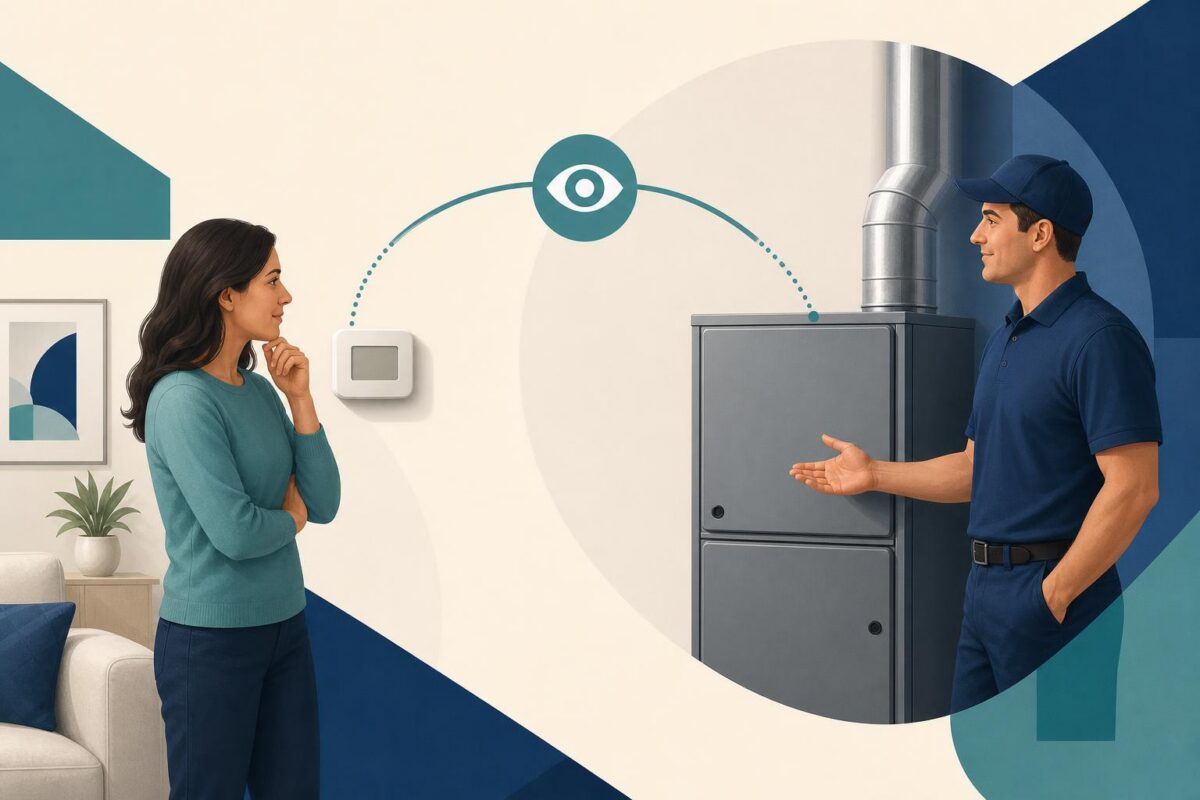
Honeywell Home visual support could help at the boundary between a homeowner’s control question and an HVAC contractor’s service investigation. The homeowner sees the thermostat and the result in the room. The contractor needs a specific description of the controls, reported behavior, and work already attempted. Those perspectives do not always arrive together.
This makes the Honeywell Home brand within Resideo’s product context a strong prospective fit for Viewabo. The analysis is independent and does not claim that Honeywell Home or Resideo uses or endorses Viewabo.
Retail and contractor paths need a common case description
Resideo’s January 2019 account of its Honeywell Home product introductions discusses thermostat products presented to consumers and to professional contractors. That is useful historical context for a support journey that can involve more than one organization.
Consider a hypothetical customer who contacts support about a control display while a contractor later needs to assess the heating or cooling system. The first conversation should preserve what the customer actually observed rather than turn it into a confirmed equipment diagnosis.
Begin with the intended result, the relevant control identity, and the reported sequence. What was the customer trying to do? Which information did the control show? What happened in the space? These questions can prepare an investigation without asking the homeowner to become a technician.
Honeywell Home visual support could clarify the control reference
A shared view may help identify the accessible thermostat or control and the information visible through normal use. This can resolve confusion between similar-looking products or between the main control and another household device.
The agent should use the appropriate identification process and product guidance. A visual resemblance is not enough to select technical instructions. If the identity remains uncertain, record that as an unanswered question for the next owner.
Also, keep the request focused. The contractor does not need unrelated household details to understand a control complaint. Explain which observation would change the next decision so the customer can provide proportionate context.
Preserve symptoms without assigning premature blame
A control message, an unexpected room condition, and the customer’s impression of equipment behavior are distinct observations. They may be related, but the relationship needs the appropriate technical assessment. Support should not assume the thermostat caused every heating or cooling concern.
Our recommendation is to carry the customer’s timeline into the handoff. Include relevant changes they report and the results of approved user-level checks. Label earlier events as reported rather than presenting them as observations made during the contact.
Viewabo could help connect the physical control to that account. It does not inspect the system, determine electrical compatibility, or replace contractor judgment. The value is a clearer first question for the person qualified to continue.
Keep homeowner guidance separate from service work
Do not ask the customer to expose wiring, open service panels, or make changes outside their permitted role to extend the conversation. An accessible view of a control is different from a technical inspection of the equipment behind it.
If the reported condition requires urgent attention, follow the relevant emergency or service guidance. The support process should not delay the appropriate response while gathering additional routine evidence.
For a nonurgent contractor visit, explain the remaining question and the purpose of the visit. Assessment, repair, and operating guidance are different tasks. Clear scope helps the customer understand what the contractor can reasonably be expected to establish.
Give each party a clear next responsibility
Furthermore, the homeowner should not have to mediate competing assumptions between product support and a service contractor. A useful handoff identifies the next owner, the evidence already available, and the specific result that needs further work.
HVAC service triage turns a homeowner description into a site-specific brief without asking the homeowner to perform technical work.
In addition, commercial decisions need the proper authority. A technical-support conversation should not imply approval for repairs or costs that the customer has not accepted. Keep diagnosis, authorization, and execution distinguishable in the normal service process.
After the contractor’s work, return the relevant outcome to the original support question. A completed visit may leave an operating question unresolved, and a clarified control setting may not settle the reported equipment concern. The case should reflect that honestly.
Evaluate the handoff, not just the first contact
A Honeywell Home visual support pilot could review cases transferred from remote intake to HVAC service. Assess whether control identity is correct, whether the customer’s reported sequence survives, and whether the contractor repeats basic intake questions. Include the final customer outcome in the evaluation.
These are measures for testing the approach, not promised improvements. A shorter initial contact is not necessarily useful if the next person begins with less context. The objective is continuity across the support boundary.
The broader case for video in customer support fits the moment when a visible household control must become a usable service brief. Honeywell Home could evaluate Viewabo where that shared understanding gives the contractor a more precise starting point.